You've probably seen the pitch: "Find winning stocks in seconds with AI." It usually describes an AI stock screener — and screeners are genuinely useful. But there's a quieter, more important question hiding underneath the marketing: once the screener hands you a list of tickers, then what?
A screener and an AI stock research platform sound like the same product. They're not. One narrows a universe of thousands of stocks down to a shortlist worth a closer look. The other does the closer look. Confusing the two is how people end up buying a stock because it "passed the screen" without ever understanding the business behind it.
This guide draws the line clearly: what an AI stock screener does well, where it stops, and what a full research platform adds. By the end you'll know which one you actually need — and the honest answer, for most serious investors, is both, in order.
What an AI stock screener actually does#
A stock screener is a filter. You give it rules — "P/E under 20, revenue growth over 15%, market cap above $2B, positive free cash flow" — and it returns every stock in the universe that matches. The "AI" versions add natural-language queries ("show me profitable small-caps growing faster than their sector") and sometimes a composite score that ranks the survivors.
That's a real and valuable job. Screening is how you turn an impossible universe of ~6,000 US stocks into a manageable list of ten or twenty candidates. It's fast, cheap, and objective. If you want to systematically surface names that fit a strategy — cheap compounders, high-momentum growth, dividend payers — a screener is exactly the right tool.
Its two core functions are worth naming precisely:
- Filtering by predefined metrics. You already know the criteria; the screener applies them across the whole market at once. See the glossary if terms like free cash flow or EV/EBITDA are new.
- Surfacing candidates. The output is a list — a starting point, not an answer. Sometimes a screener also helps with discovery: nudging you toward names you weren't already watching that fit a pattern.
Where the screener stops#
Here's the critical limitation, and it's structural, not a knock on any particular product: a screener judges stocks by the boxes they tick, not by whether the business is any good.
A stock can pass a pristine value screen because its earnings are about to collapse and the market already knows it — the "cheap" multiple is a trap, not an opportunity. Another can fail a growth screen this quarter because of a one-time charge that says nothing about the underlying trajectory. Metrics are snapshots; businesses are stories. A filter can't read the story.
So a screener won't tell you:
- Why the numbers look the way they do, or whether they're sustainable.
- Whether the company has a durable competitive advantage or is about to lose one.
- What the latest earnings call revealed, or how management's guidance is trending.
- What the bear case is — the specific things that would make this a mistake.
- How much to trust any of it, given how fresh and complete the underlying data is.
That gap — between "this ticker matched my filter" and "I understand this company well enough to have a view" — is exactly the work most people skip. Our 12-step guide to researching a stock is a map of everything that lives in that gap.
The research spectrum: screen → discover → research → thesis#
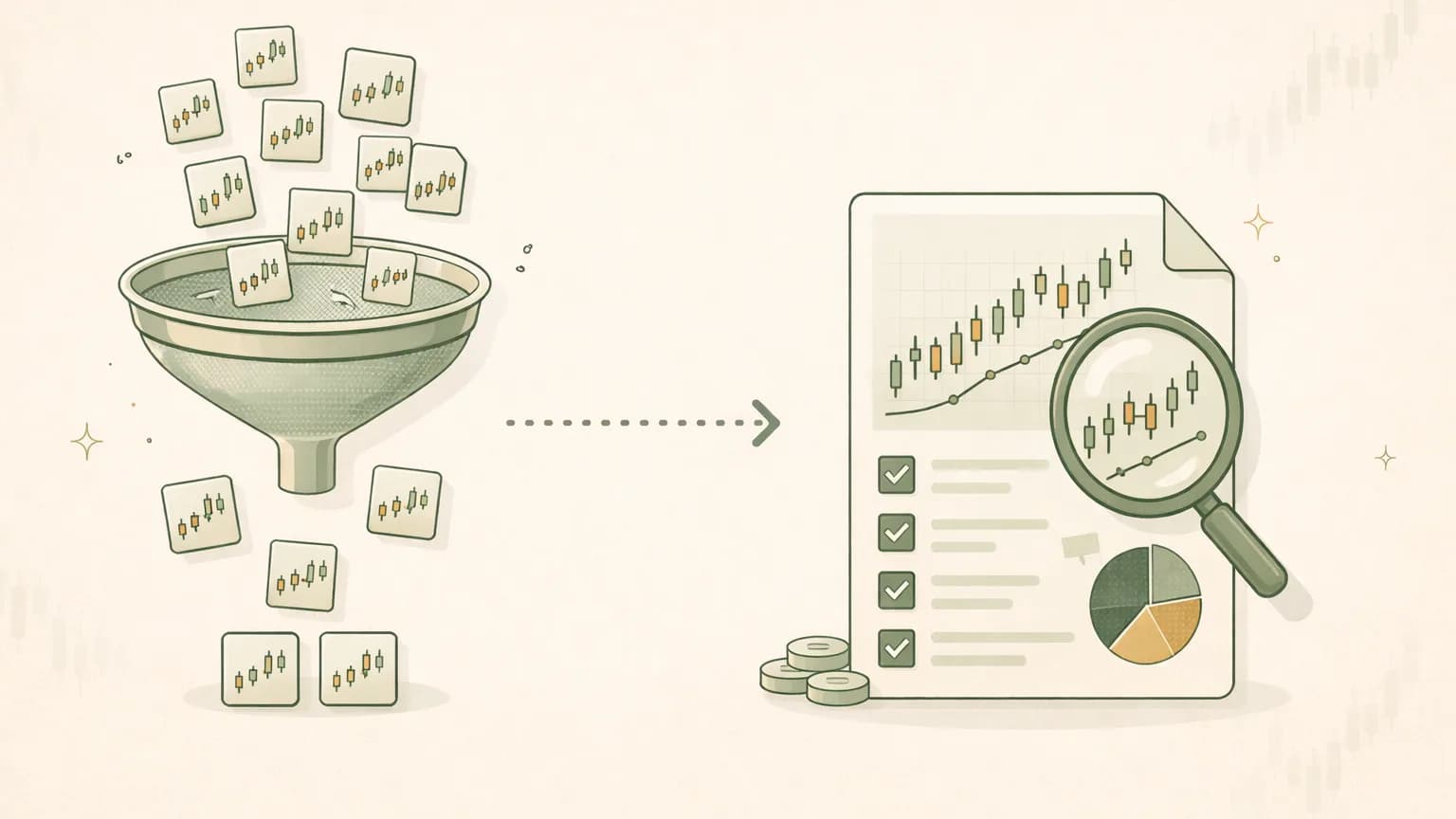
It helps to see these as stages of one funnel, not competing products:
- Screen — filter the whole market down to candidates that fit your criteria.
- Discover — surface interesting names and patterns you weren't already tracking.
- Research — investigate each candidate: business model, financials, valuation, news, sentiment, technicals, catalysts, and risks.
- Thesis — synthesize all of that into a clear, defensible view, with the bull case and the bear case both on the table.
A screener owns stages 1 and 2. An AI stock research platform owns stages 3 and 4 — the part where a shortlist becomes understanding.
What an AI stock research platform adds#
If a screener asks "which stocks match my rules?", a research platform asks "what is actually true about this company, and how confident can I be?" That's a fundamentally deeper task, and it's the job Valarn is built for — as an educational research tool, not a signal generator.
Instead of one scoring model rating everything, a deep Valarn report convenes up to about 25 specialist AI analysts, each responsible for one slice of the investigation, organized into five areas: core research, market structure, a debate-and-risk committee, financial-quality reviewers, and events/sector/macro coverage. Concretely, that means a single company gets:
- Full fundamental and valuation research — the business model, revenue quality, margins, cash flow, balance sheet, and valuation versus peers, not just the ratios a filter can see.
- News, sentiment, technical, catalyst, and risk analysis — each handled by the part of the system built for it, rather than blended into one number.
- A structured bull-versus-bear debate — one side building the case for, another tasked with tearing it down — before any conclusion is drawn.
- A final research view with the reasoning attached — expressed as a neutral posture (Bullish, Cautious Bullish, Neutral, Cautious, or Bearish), never a "buy" or "sell" order.
And crucially, every factual claim is traceable to a filing or licensed data source with an as-of date, and each report carries a confidence score reflecting how solid that underlying data actually is. You can see what a finished one looks like in a full sample report.
Screener vs. research platform, side by side#
| AI stock screener | AI stock research platform |
|---|---|
| Filters a whole universe by your rules | Investigates one company in depth |
| Output is a ranked list | Output is a reasoned thesis |
| Judges by metrics that tick boxes | Judges by the business behind the metrics |
| One scoring model | Up to ~25 specialist analysts across 5 areas |
| No sources; a score | Every claim tied to a filing, with an as-of date |
| No opposing view | A structured bull-vs-bear debate |
| Great for the top of the funnel | Great for the decision at the bottom |
Many agents vs. one scoring model#
The deepest difference is the shape of the intelligence. A screener's "AI" is typically one model producing one score — a single number that collapses a company into a rank. That's fine for sorting a list. It's a poor foundation for a decision, because a single score can't tell you where it's uncertain or what the other side of the argument is.
A multi-agent research platform is built the opposite way: many specialists that are meant to disagree before anything reaches you. A question about accounting quality gets answered by the reviewer built to scrutinize accounting; a question about the chart, by the one that reads price action. Then they argue. It's much harder for a whole committee of specialists to wave away an awkward detail than it is for a single score to bury it. If you want the fuller version of that argument, we wrote about why one AI answer falls short.
So which do you need?#
Both — and the order matters:
- Use a screener to go from the whole market to a shortlist. It's the right tool for the top of the funnel: fast, systematic, and built to surface candidates.
- Use a research platform to go from a shortlist to a decision. It's the right tool for the bottom of the funnel, where "it passed my screen" has to become "I understand this company and its risks."
The mistake isn't using a screener. The mistake is stopping at the screener — treating a filtered list as if the research were already done. A screen tells you a stock is worth a look. It never tells you the look is finished.
A practical workflow: screen for candidates, then run each survivor through real research — separating the facts from the assumptions, reading both sides, and checking how solid the evidence is. When you're ready to research a specific name, a company research page is a good place to start, or you can run a free report on the next ticker your screen surfaces.
The bottom line#
An AI stock screener and an AI stock research platform aren't rivals — they're consecutive steps. The screener answers "which stocks should I look at?" The research platform answers "what do I actually think, and how sure can I be?" One narrows the field; the other does the homework. Buy on the first without the second, and you've mistaken a filter for a conclusion.
Screen to find candidates. Research to make a decision. Don't confuse the two.
Valarn is an educational research tool, not investment advice. It does not tell you to buy, sell, or hold anything, and nothing here is a recommendation or a promise of results. Always do your own research and consider consulting a licensed financial professional.
Valarn
AI Research
Valarn Research Team
