
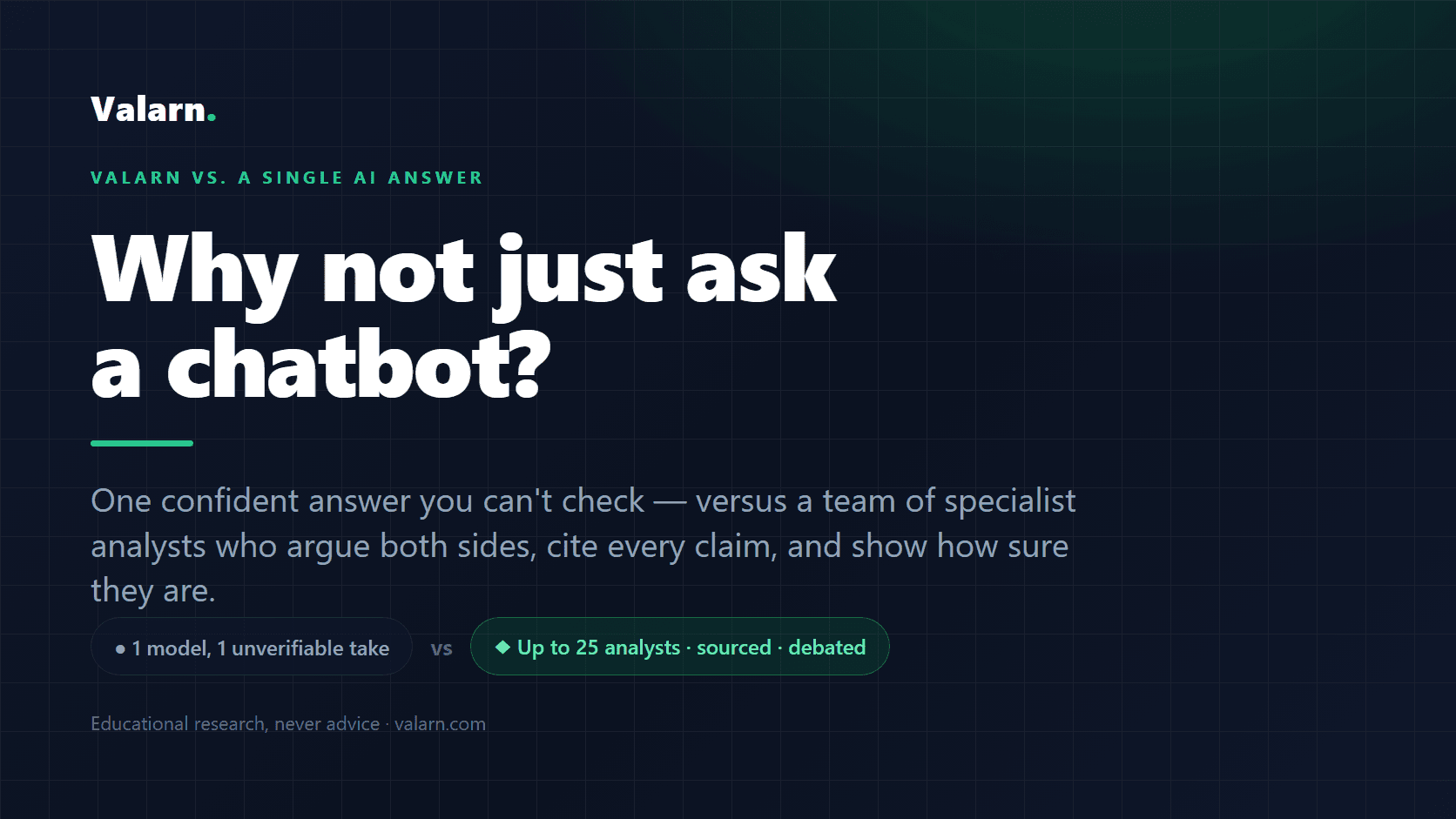
You paste a ticker into your favorite chatbot and ask, "Is this a good company?" Thirty seconds later you get a clean, confident, well-organized answer. Revenue growth, a moat, a couple of risks, a tidy conclusion. It reads like it was written by someone who knows exactly what they're talking about.
So here's the uncomfortable question: how would you know if it was wrong?
The problem isn't that chatbots are dumb. It's that they're fluent.#
A general-purpose AI is very good at producing text that sounds like analysis. That's literally what it was built to do. But fluent and correct are not the same thing, and when money is involved, the gap between them is exactly where you get hurt.
When a chatbot tells you margins are "expanding nicely" or a lawsuit is "unlikely to be material," where did that come from? Which filing? Which quarter? Is it this year's number, or a figure the model half-remembers from training data? You usually can't tell. The answer arrives as one smooth paragraph with no receipts — and it looks exactly the same whether it's standing on bedrock or thin air.
Underneath that confident tone, four things are usually missing:
- You can't check it. Claims arrive without sources, so you can't verify them — you're trusting the tone.
- There's no opposing view. A single answer picks a lane and commits. The strongest counterargument — the thing that should worry you — often just doesn't appear.
- There's no built-in stress test. "Here's why this looks interesting" is easy to generate. "Here's what would have to go wrong" is the harder, more valuable half, and it's usually absent.
- There's no honest signal of how solid it is. The model sounds equally sure on fresh, complete data or thin, stale, conflicting scraps.
None of this means the chatbot is lying. It means you're handed the conclusion without the reasoning you'd need to judge the conclusion. For deciding what to skim on a Friday night, fine. For your actual savings, "trust me" is a weak foundation.
What a research desk actually does differently#
Walk onto any professional research desk and you'll notice something: nobody works alone. One analyst lives in the financials. Another watches how the stock actually trades. Someone obsesses over industry cycles; someone else pokes holes in everyone's assumptions. Before a single view goes out the door, they argue — both sides, on the record — and someone checks the work.
Valarn is built to bring that process to individual investors, as an educational research tool — not a single oracle handing down a verdict.
Up to ~25 specialists, each staying in their lane#
Instead of one model answering everything, a deeper Valarn report can convene up to about 25 specialist AI analysts, each focused on one domain, organized into five areas:
- Core Research — the fundamental business and thesis work
- Market Structure — how the stock trades, liquidity, positioning
- Debate & Risk — the analysts whose job is to argue and stress-test
- Financial Quality — the health and reliability of the numbers
- Events, Sector & Macro — catalysts, industry context, the bigger backdrop
You don't always need the whole roster. Lighter, faster reports use a focused subset when you want a quicker read; the deepest "Deep Debate" report brings in the full team. The point isn't "more AI is automatically better." It's that a question about accounting quality should be answered by the part of the system built to scrutinize accounting — not by a generalist improvising across everything at once. And it's much harder for a whole group of specialists to wave away an awkward detail than it is for a single voice to smooth it over.
Every claim comes with a receipt#
A confident sentence with no source behind it is just a nice sentence. So Valarn is built so that every factual claim is traceable back to where it came from — SEC and regulatory filings, official disclosures, licensed market data — each with an "as-of" date so you know how fresh the number is.
And when sources disagree — say a figure in one filing doesn't line up with another — Valarn surfaces the conflict instead of quietly picking one and moving on. A chatbot smooths over contradictions because a smooth paragraph reads better. Honest research leaves the seams showing, because the seams are often the most important part of the page.
That includes third-party opinions, too — but framed as what other people are doing, not as Valarn's own conclusion. If Wall Street analysts rate something a "buy," or a member of Congress disclosed a sale, that's reported as their action, cited and dated, kept clearly separate from Valarn's read of the situation.
A real argument, not a one-sided pitch#
Here's where it gets genuinely different. Valarn doesn't just gather opinions and average them. It runs a structured bull case versus bear case — one side assembling the reasons for optimism, the other tasked with tearing it down — and only then synthesizes them into a single research view.
Why force the fight? Because a single AI answer tends to anchor on whatever framing you gave it and defend it. A deliberate debate is designed to surface the blind spots the optimistic version conveniently skipped — the strongest reasons you might be wrong, stated as forcefully as the reasons you might be right, before they surface in your portfolio instead. You get to read both arguments and judge which one holds up, rather than being handed a verdict on faith.
And that final synthesis is expressed as a neutral research view — Bullish, Cautious Bullish, Neutral, Cautious, or Bearish — not as a "buy" or "sell" instruction barked at you. It's a considered stance you can interrogate, not a command to act on.
A confidence score — and a quality gate#
Every Valarn report carries two numbers that answer different questions. A 0–100 confidence score reflects how complete and reliable the underlying data is — thin, stale, or conflicting inputs pull it down. A separate agreement score captures how much the specialist analysts actually converged versus split. High confidence with low agreement tells you something real: the data was solid, but reasonable analysis still points in different directions. That's honest, and it's useful.
One important clarification: confidence is not a prediction. It's a read on the quality of the evidence behind the analysis — calibration, not a crystal ball. Nobody here is claiming to see where the stock is headed. And before any report reaches you, it passes through a quality-assurance gate — the equivalent of a desk editor checking the work — a step a one-shot chatbot answer simply doesn't have.
Side by side#
| A single AI answer | Valarn |
|---|---|
| One general model, one take on everything | Up to ~25 specialist analysts across 5 categories |
| Sounds sure; source unknown | Every factual claim traceable to filings, disclosures, licensed data |
| Picks a lane; counterargument often missing | Structured bull-vs-bear debate, then one research view |
| Conflicts and staleness smoothed over | Conflicting sources surfaced, with as-of freshness |
| Equally confident on thin or solid data | Explicit confidence score and agreement score |
| No review before you read it | Passes a QA gate first |
| A conclusion to trust | Reasoning you can actually judge |
The bottom line#
You can just ask a chatbot — and for "explain what a P/E ratio is," go ahead. But for a real research decision, the question isn't "what's the answer?" It's "can I check the answer, see the other side, and tell how solid it is?"
That's the line Valarn is drawn along: many specialists instead of one voice, a source under every claim, a genuine argument instead of a one-sided pitch, and an honest signal of how much to trust the whole thing. Not a verdict handed down — a body of reasoning you can inspect, poke at, and disagree with. The goal isn't to replace your judgment. It's to give your judgment something real to chew on.
A confident answer is easy. A checkable one is the point.
Valarn is an educational research tool, not investment advice. It does not tell you to buy, sell, or hold anything, and nothing here is a recommendation or a promise of results. Always do your own research and consider consulting a licensed financial professional.
Valarn
Valarn Research Team
