
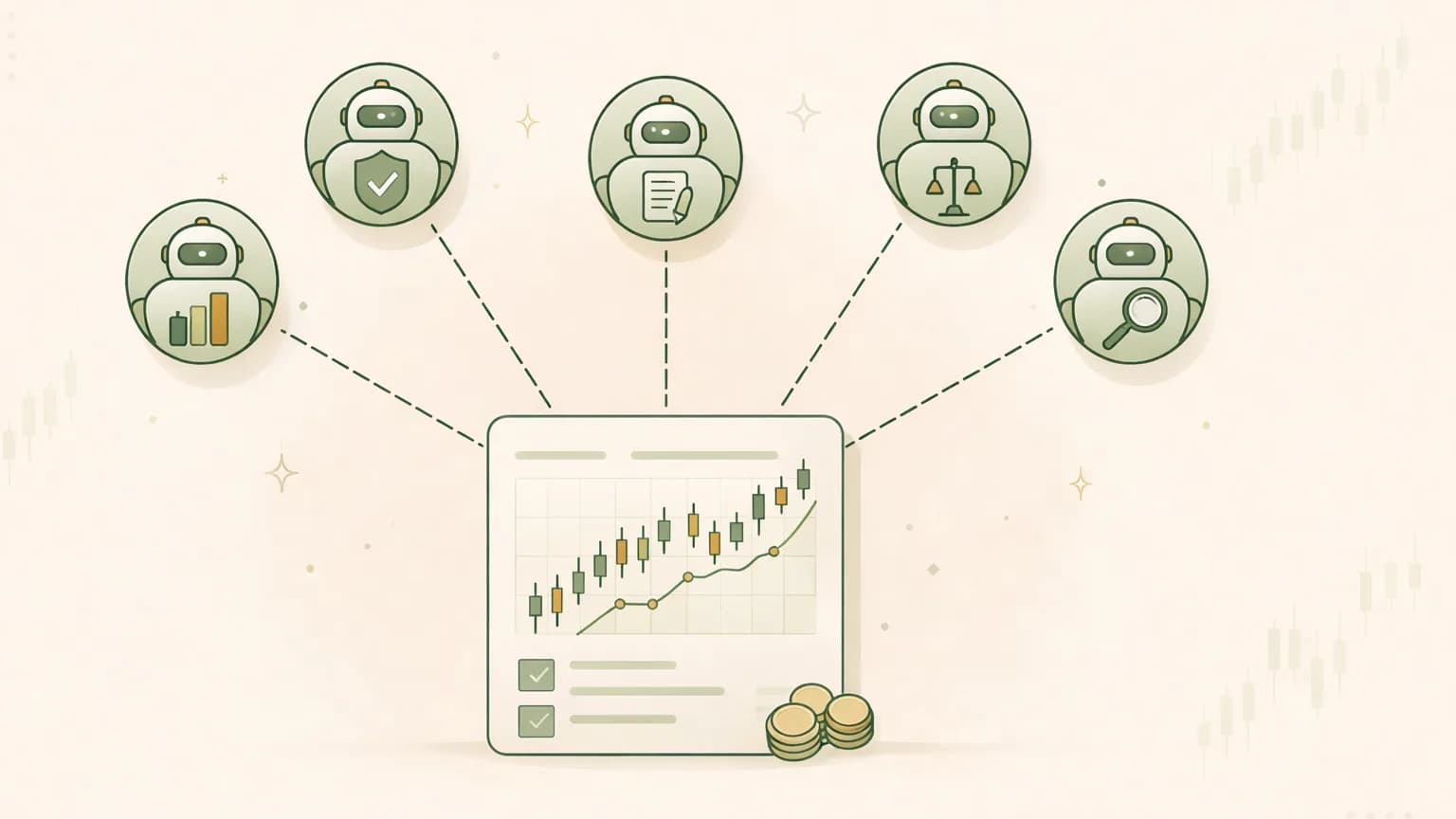
Ask an AI to analyze a stock and you'll usually get one model doing everything at once — skimming the business, guessing at valuation, sampling the news, and handing you a single confident paragraph with maybe a number stapled to the end. It reads well. That's the trap. One generalist making one pass has no way to disagree with itself, and no way to show you where its own case is weak.
The alternative is to stop asking one model to be an entire research department. AI agents for stock analysis flip the model: instead of one system that does a little of everything, you run a team of narrow specialists, each responsible for one slice of the work — fundamentals, valuation, cash flow, sentiment, technicals, catalysts, risk — and then you make them argue before anyone writes a conclusion.
This guide walks through how that actually works: what each agent does, why grounding every claim in filings matters, how a structured bull-versus-bear debate turns a pile of opinions into a single research view, and how confidence and agreement scores tell you how much weight that view deserves. The point isn't a slicker answer. It's a checkable one.
Why one model and one score isn't enough#
A single general-purpose model has real strengths — it's fast, it's fluent, and it can summarize a lot of ground. But financial analysis punishes exactly the things a generalist is bad at.
The first problem is breadth masquerading as depth. Fundamentals, valuation, and sentiment are genuinely different disciplines. The skills that let you read a cash-flow statement are not the skills that let you interpret unusual options activity or judge whether a news cluster actually changes a thesis. When one model handles all of them in a single pass, each gets a thin, surface-level treatment — and the writing sounds equally authoritative about the parts it did well and the parts it half-did.
The second problem is no internal disagreement. A lone model has no structural reason to build the strongest case against its own conclusion. It tends to pick a direction early and then narrate toward it, because that produces the smoothest prose. The most important part of research — the reason you might be wrong — is the part a single confident pass is most likely to skip.
The third problem is one score with no meaning. A general model that ends with "7/10" or a made-up price target gives you a number with no anatomy. Is that a strong conclusion built on fresh filings, or a shaky one stitched from stale training data? You can't tell, because the score compresses data quality, agreement, and prediction into a single digit that explains none of them. (This is a big part of why an AI stock research platform is a different animal from an AI stock screener — the screener ranks, the research desk reasons.)
What "specialist AI agents" actually means#
The core idea is division of labor. Instead of one model wearing every hat, each agent is given one job, one lens, and the data that job needs — and it's judged only on that slice. Think of it as a research desk where every seat has a specialist in it.
A well-designed roster covers the same ground a human analyst team would, split roughly like this:
- The business and fundamentals — how the company makes money, revenue trends, margins, and financial quality. Is the growth real and durable, or dressed up with new metrics?
- Cash flow and the balance sheet — does reported profit turn into actual cash, and can the company survive a bad year? Earnings are an opinion; cash is a fact.
- Valuation — what you're being asked to pay for that stream of cash, measured against the company's own history and its peers, never in a vacuum.
- Ownership and insiders — what executives, directors, and institutions are doing, reported as third-party filings rather than as instructions.
- Sentiment and news — how the crowd feels and whether recent headlines actually change the story or just the mood.
- Technicals — what the price and volume are doing, kept firmly in their lane as a description of crowd behavior and timing, not a verdict on the business.
- Catalysts, sector, and macro — what's coming (earnings, launches, regulatory decisions) and the industry and economic backdrop those events land in.
- Risk — a dedicated seat whose entire job is to find what breaks the thesis.
Splitting the work this way is the whole reason multi-lens analysis beats a single narrator. Each of these disciplines answers a different question, and blending them into one pass loses the distinctions — which is exactly the tension we unpack in fundamental vs. technical vs. sentiment analysis. A specialist can go deep on its slice precisely because it isn't also trying to do the other seven.
Grounding: every agent starts from the filings, not from memory#
Specialization only helps if the specialists are working from real evidence. This is where a lot of AI analysis quietly falls apart: a fluent model reconstructs a "revenue figure" from half-remembered training data, presents it as current, and you have no way to know it's months stale or simply invented.
The fix is grounding. Before an agent reasons, it's fed primary sources — SEC filings (10-Ks and 10-Qs for the financials, Form 4s for insider transactions), market data, and licensed feeds — and its job is to interpret those, not to freelance from memory. Two rules make this trustworthy:
- Traceability. Every material claim — a margin, a debt maturity, an insider sale — should point back to where it came from. A claim you can't trace isn't research; it's an assertion in a nice font.
- An as-of date. Numbers go stale. Stamping each data point with the date it's current as of is the difference between "here's the latest filing" and "here's something that sounds right." If a term or filing type is unfamiliar, the glossary explains what each one contains.
Grounding is also the single biggest defense against hallucination. An agent working from a document can be checked against that document; an agent floating free of sources can't be checked at all. It's the foundation for the trust checklist we lay out in can you trust AI stock analysis — and it only works because each specialist is close enough to its own slice to actually read the primary source rather than skim it.
The part most tools skip: the bull-versus-bear debate#
Here's where a multi-agent process stops being "several summaries in a trench coat" and becomes something genuinely different.
Once the specialists have done their work, the strongest bull case and the strongest bear case are built as opposing arguments — deliberately, adversarially, each drawing on the specialists' findings. One side assembles every reason the thesis holds. The other side attacks it: the margin that's quietly eroding, the customer concentration nobody's pricing in, the valuation that only works if growth never slows. Then a risk seat pressure-tests both.
This matters because a one-sided report is a red flag no matter how well argued. If the best reason you might be wrong is missing, the most important part of the analysis is missing. Forcing the disagreement into the open does two things a single model can't: it surfaces the weak points of the bullish story, and it stops the bearish story from being a lazy "everything is terrible" that ignores the actual strengths.
There's also a reliability payoff. When multiple specialists have to reconcile their views against each other, a claim that only one agent invented tends to get challenged rather than waved through — which is the mechanism behind why multi-agent debate reduces AI hallucination. Structured disagreement is a feature, not a bug.
From debate to a single research view#
A debate you can't resolve is just noise, so the last step is synthesis: the arguments are weighed and reconciled into one research view. Crucially, that view is a neutral stance, not an order. In Valarn's case the ladder runs Bullish, Cautious Bullish, Neutral, Cautious, or Bearish — a description of what the evidence leans toward, never "buy" or "sell." The distinction isn't a legal nicety; it's the honest limit of what analysis can tell you. Research clarifies a situation. What you do about it is yours.
Just as important, the platform's own view is reported separately from what Wall Street thinks. Analyst ratings and price targets are real, useful facts — so they're presented as third-party facts, sitting alongside the independent research view rather than being blended into it. You get to see where the machine's read agrees or disagrees with the Street, instead of having the two quietly averaged into mush.
Two scores that tell you how much to trust the view#
A conclusion is only as useful as your sense of how much to lean on it. This is where two separate 0–100 scores do far more work than one vague number:
- Confidence measures data quality — how fresh, complete, and consistent the underlying evidence is. It is not a prediction that the stock will go up or down. A high confidence score says "the inputs to this analysis are solid," which is a completely different claim from "this will work out." Thin, stale, or conflicting data should drag confidence down, and honest analysis lets it.
- Agreement measures how much the specialists converged. When most agents point the same direction, agreement is high and the view is coherent. When the fundamentals look strong but sentiment and technicals are flashing caution, agreement is low — and that tension is information, not something to paper over.
Keeping these two apart is what makes them useful. Here's an illustrative example (numbers for illustration only): a report might carry confidence 82 because it's built on a just-filed 10-Q with clean, consistent data — while showing agreement 54 because the valuation and cash-flow agents like the setup but the technical and sentiment agents don't. That combination tells you something a single "7/10" never could: the facts are reliable, but the specialists disagree about what they mean. That's your cue to read the debate, not just the headline.
Scenario range instead of a fake price target#
Notice what's deliberately missing from all of this: a single confident price target. A precise number like "fair value: $214" implies a precision that no honest analysis has. Instead, a well-built process gives you a scenario range — a bear, base, and bull case — anchored to a reference price and paired with a risk level.
That framing is more truthful because it matches how the future actually behaves: as a spread of outcomes with different likelihoods, not one predestined figure. It also connects straight back to the debate — the bull and bear cases you argued out become the top and bottom of the range, so the number you're looking at is visibly the product of the reasoning, not a guess dropped in at the end.
The quality-assurance gate before anything reaches you#
The final piece is oversight. Before a synthesized report is delivered, it passes a QA gate — a structured check that the claims are sourced, the data isn't stale, the required sections are present, and nothing contradicts itself. Think of it as the editor who reads the desk's work before it ships, catching the sourced-but-stale figure or the conclusion that drifted from its evidence.
This is the "structured oversight" that separates a research process from a one-off performance. A single model has no editor; it emits its first draft as its final answer. A multi-agent desk with a QA gate is built to catch its own mistakes before you inherit them.
One model vs. a multi-agent research desk#
Here's the contrast in one view:
| Single general model | Multi-agent research desk | |
|---|---|---|
| Coverage | One pass over everything, thin per topic | A specialist per slice, deep on each |
| Evidence | Often reconstructed from memory | Grounded in filings/data with as-of dates |
| Disagreement | None — narrates toward one view | Explicit bull-vs-bear debate |
| Output | One score / one price target | Research view + confidence + agreement + scenario range |
| Trust signal | "Sounds confident" | Traceable claims, QA gate, readable trail |
| Wall Street view | Blended in or ignored | Reported separately as third-party fact |
The table isn't saying a general model is useless — it's fast and genuinely helpful for a first pass. It's saying the two things are built for different jobs.
How this comes together in Valarn#
Everything above describes an architecture, and it's the one Valarn runs as an educational research tool. A single analysis convenes up to about 25 specialist AI analysts organized into five groups — Core Research, Market Structure, Debate & Risk, Financial Quality, and Events/Sector & Macro — covering fundamentals, valuation, financial quality, cash flow, insider and ownership activity, sentiment and news, technicals, catalysts, sector, and macro.
Those specialists feed a formal bull-versus-bear debate, which resolves into one neutral research view — never a buy/sell instruction. Every factual claim is traceable to a filing or licensed source with an as-of date; the report carries the two 0–100 scores (confidence for data quality, agreement for analyst convergence); it frames outcomes as a scenario range with a reference price and risk level instead of a single target; and it reports Wall Street consensus separately from its own view. A QA gate runs before any of it reaches you. You can see how the pieces fit together on the features overview or the why-Valarn page.
The honest promise here is narrow on purpose: not that this predicts the market, but that it gives you a research process you can actually inspect. If you want to see it on a real company, skim a complete sample report, look up any ticker on a company research page, or run your own free analysis and read the debate for yourself.
The bottom line#
The shift from "ask one AI" to "run a team of specialist AI agents for stock analysis" isn't about a fancier answer. It's about structure: narrow experts grounded in filings, forced to argue both sides, synthesized into a neutral research view, scored for data quality and agreement, framed as a range rather than a prophecy, and checked by a QA gate before you ever see it.
A single confident paragraph asks you to trust the tone. A multi-agent process hands you a trail you can walk from the sources to the conclusion — with the disagreements left visible. Understand how the agents work, and you'll know exactly which parts of any AI report to believe and which to interrogate.
Valarn is an educational research tool, not investment advice. It does not tell you to buy, sell, or hold anything, and nothing here is a recommendation or a promise of results. Always do your own research and consider consulting a licensed financial professional.
Valarn
AI Research
Valarn Research Team

Try Valarn for free
Run AI-powered analysis on any stock — typically 5–20 minutes per report.