
Everyone tracks revenue. It's the top line, it's on every headline, and it feels like the truth about how a business is doing. But for subscription and contract-heavy companies, revenue is the slowest of three related numbers — and the two faster ones, bookings and billings, often tell you where revenue is heading before revenue itself catches up.
Understanding bookings vs billings vs revenue is one of those skills that quietly separates people who can read a SaaS company from people who just react to the headline. The three numbers describe the same customer contract at three different moments: when it's promised, when it's invoiced, and when it's earned. Mix them up — or watch only the last one — and you'll be reading the story a lap behind.
This guide walks through what each number actually measures, how they lead and lag one another, and why billings in particular is treated as a forward indicator for recurring-revenue businesses. No accounting degree required; just a willingness to keep three ideas straight.
Three numbers, three moments in time#
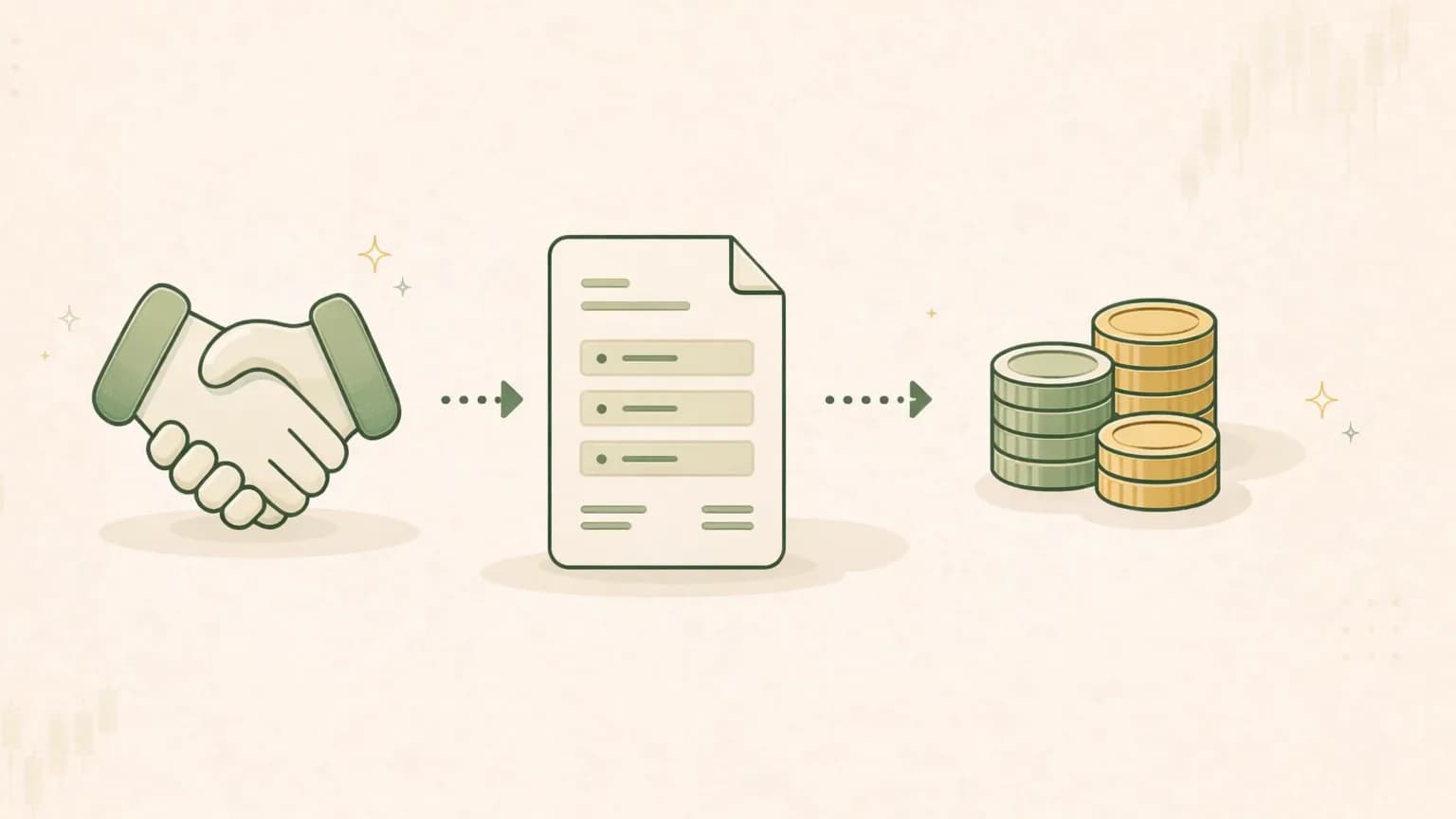
Here's the whole thing in one breath. A customer signs a contract (a booking). At some point the company sends an invoice for part or all of it (a billing). Then, as the service is actually delivered, the company is allowed to count it on the income statement (revenue).
The same dollars flow through all three, but at different times and under different rules:
| What it measures | GAAP number? | When it's recorded | Ties to | |
|---|---|---|---|---|
| Bookings | Total value of contracts signed (the promise) | No — company-defined | At signing | Future demand, backlog |
| Billings | Amount actually invoiced to customers | No — usually estimated by analysts | When invoiced | Cash, deferred revenue |
| Revenue | Value of service already delivered (earned) | Yes | As delivered, over time | Income statement |
The key insight is the ordering. Bookings tend to lead billings, and billings tend to lead revenue. When a business is accelerating, you often see it in bookings and billings before it shows up in the revenue line — which is exactly why sophisticated readers watch all three instead of just the one everyone quotes.
Let's take them one at a time.
Bookings: the promise#
A booking is created the moment a customer commits — when the contract is signed. It represents the total value of what the customer has agreed to pay over the life of the deal, whether that's one year or five.
If a customer signs a three-year deal worth $120,000 a year, the booking is generally the total contract value: $360,000. Not a dollar of it has been invoiced yet. Not a dollar has been earned. But the company now has a signed obligation on both sides, and that promise is the earliest signal of demand you can get.
Why bookings are useful — and slippery#
Bookings are the leading edge of the whole chain. Rising bookings mean the sales engine is landing more and bigger deals, which will eventually convert into invoices and then revenue. Falling bookings are an early warning that the top of the funnel is drying up, often quarters before revenue notices.
But here's the catch: bookings are not a GAAP number. There's no single accounting rule for what counts, so definitions vary from company to company. One firm counts only new business; another lumps in renewals and upsells. Some count the full multi-year value; others count just year one. A few include deals that are signed but easy to cancel.
That flexibility makes bookings genuinely useful and easy to dress up. When a company emphasizes a booking number, the honest first question is always: what exactly is in it, and how is that different from last year's definition? Treat bookings as a directional signal, not a precise figure — and be wary when a company leans on bookings growth while billings and revenue quietly lag.
Billings: the invoice#
A billing happens when the company actually sends an invoice. This is the number that matters most for cash and, as it turns out, the one that often predicts revenue best.
Billings sit in the middle of the chain for a reason. A customer doesn't always get invoiced for the whole contract up front. On an annual subscription, the company might bill 12 months at once; on a multi-year deal, it might bill one year at a time. So billings in any given quarter reflect the invoices actually issued that quarter — cash the company can expect to collect soon.
The billings formula#
Most companies don't report billings directly, so analysts estimate it. The standard proxy — often called calculated billings or implied billings — is:
Calculated billings = Revenue + Change in deferred revenue (over the period)
The logic is clean once you see it. Revenue captures what the company earned this period. The change in deferred revenue captures money it invoiced but hasn't earned yet (deferred revenue is the liability that holds pre-paid, not-yet-delivered subscription dollars). Add the two together and you've reconstructed roughly what got invoiced. It's an estimate, not a reported GAAP figure — but a widely used one.
Why billings is a forward indicator#
Because invoicing tends to happen before the service is fully delivered, billings often move ahead of revenue. A quarter of strong billings loads up deferred revenue, and that deferred balance gets recognized as revenue in the quarters that follow. In effect, billings today is a preview of revenue tomorrow.
That's why analysts of recurring-revenue businesses obsess over billings growth. If billings are accelerating while reported revenue is still catching up, the revenue line has tailwind behind it. If billings are decelerating while revenue still looks fine, that's a yellow flag the headline hasn't priced in yet. Billings is where the future shows up first.
One honest caveat: because billings depend on invoice timing, they can be lumpy. A big multi-year deal billed up front can spike billings in one quarter and leave the next looking soft — with nothing actually wrong. That's why you read the trend over several quarters, and read it alongside the contract terms, rather than reacting to a single number.
Revenue: the earned number#
Revenue is the strict one. It's governed by accounting rules (in the US, the ASC 606 standard, Revenue from Contracts with Customers), and the core principle is simple: you can only recognize revenue as you deliver the service, not when you sign the deal or send the invoice.
For a subscription business, that usually means recognizing revenue ratably — spread evenly over the life of the contract. Invoice a customer $12,000 for a one-year subscription and you don't book $12,000 of revenue on day one. You book roughly $1,000 a month as the year unfolds. The other $11,000 waits in deferred revenue until it's earned.
This is why revenue is the lagging member of the trio. It reflects contracts signed and invoiced in the past, now being delivered. It's the most reliable and comparable of the three — a real GAAP number with real rules — but it's also the slowest to reflect a change in the underlying business. By the time a demand shift reaches the revenue line, bookings and billings have usually been telling that story for a while.
Watching the three connect: a worked example#
Numbers make this click. Take a single, simplified contract: a customer signs a one-year, $12,000 subscription, billed entirely up front, with the service delivered evenly over 12 months. Watch how the three numbers behave quarter by quarter (revenue recognized at $1,000/month, so $3,000 per quarter):
- At signing: Bookings = $12,000 (the full contract value, recorded once).
- Q1 (invoice sent): Billings = $12,000. Revenue = $3,000. Deferred revenue rises from $0 to $9,000 (invoiced $12,000, earned $3,000). Check the formula: revenue $3,000 + change in deferred $9,000 = $12,000 billings. ✓
- Q2: No new invoice, so billings = $0. Revenue = $3,000. Deferred revenue falls from $9,000 to $6,000. Formula: $3,000 + (−$3,000) = $0. ✓
- Q3: Billings = $0. Revenue = $3,000. Deferred revenue falls to $3,000.
- Q4: Billings = $0. Revenue = $3,000. Deferred revenue falls to $0 — the contract is fully earned.
Notice the sequence. The booking landed first, the billing hit up front, and the revenue trickled out over four quarters. All three describe the same $12,000 — just at different moments and under different rules. Real companies run thousands of overlapping contracts, so the lines blur into smooth trends, but the underlying mechanics are exactly this.
And notice the bridge that connects them: deferred revenue. It's the reservoir that fills when you bill ahead of delivery and drains as you earn. That's why the three numbers, deferred revenue, and a company's backlog of not-yet-delivered contracts are all really one system viewed from different angles.
Where the gaps between them matter#
The interesting information usually lives in the gaps between the three numbers, not the numbers themselves.
- Billings running well above revenue means the company is invoicing faster than it's earning — deferred revenue is building, and future revenue has momentum. For a healthy growth business, that's often the shape you'd expect to see.
- Revenue holding up while billings sag can mean the opposite: the company is still recognizing yesterday's strong bookings, but the new invoices aren't keeping pace. Revenue looks fine today because it's a lagging number; the softness shows up later.
- Bookings growing while billings and revenue don't follow deserves scrutiny. Either the deals are long-dated and haven't been invoiced yet (plausible), or the bookings definition is doing some heavy lifting (worth checking).
None of these is automatically good or bad — they're questions to investigate, not verdicts. A lumpy quarter can have an innocent explanation. The point is that watching only revenue hides all three of these signals, because revenue is the last to move.
Two related metrics show up in the same neighborhood and are worth knowing. RPO (Remaining Performance Obligations) is a GAAP-disclosed figure — the total contracted revenue not yet recognized, essentially a cleaner cousin of bookings and backlog. And annual recurring revenue (ARR) normalizes the recurring portion into a run-rate. Reading bookings, billings, revenue, deferred revenue, and RPO together gives you a far fuller picture than any one of them alone.
What to actually check#
When you're looking at a subscription or contract-driven company, a short routine keeps you honest:
- Read all three trends, not just revenue. Pull several quarters of revenue, calculated billings, and (where disclosed) bookings or RPO, and look at the direction of each.
- Recompute billings yourself. Revenue plus the change in deferred revenue gets you the proxy. If reported "billings" differs wildly from that, find out why.
- Read the bookings definition. Check the footnotes for what's included and whether the definition changed year over year. A shifting definition is a quiet red flag.
- Watch deferred revenue. A growing deferred balance supports future revenue; a shrinking one is a headwind. It's the connective tissue between the three numbers.
- Mind the timing lumps. A single up-front multi-year deal can distort one quarter's billings. Read the trend, not the point.
This kind of cross-checking — where one figure is used to validate another rather than taken at face value — is the heart of good financial analysis, and it's closely related to judging earnings quality. If you're new to reading these dynamics in context, working through a real filing on a company research page with the glossary open beside you is the fastest way to build the muscle.
How Valarn keeps the three straight#
Reconciling bookings, billings, deferred revenue, and recognized revenue across several quarters — and doing it for a portfolio of companies — is exactly the kind of patient, cross-referencing work that's easy to describe and tedious to do. It's part of what Valarn was built to handle as an educational research tool.
Instead of one AI handing you a confident paragraph about "strong revenue," Valarn runs up to about 25 specialist analysts across five categories — covering fundamentals, financial quality, cash flow, valuation, ownership, and more — so the analyst dissecting revenue recognition and deferred-revenue trends is a different, specialized lens than the one reading valuation. Every factual claim it surfaces is traceable back to a filing or licensed data source with an as-of date, so you can see exactly where a billings or deferred-revenue figure came from and how current it is.
Those specialists then stage a structured bull-versus-bear debate before the platform synthesizes a single neutral research view (Bullish, Cautious Bullish, Neutral, Cautious, or Bearish — never a buy or sell instruction). Each report carries two 0–100 scores: a confidence score that reflects the quality of the underlying data (not a price prediction), and an agreement score that shows how much the analysts converged. A quality-assurance gate checks the whole thing before it reaches you. It's the difference between a smooth answer and a checkable one.
If you'd like to see how this reads on a real company — including how the numbers behind the numbers get sourced — skim a complete sample research report, or run your own free analysis and follow the reasoning yourself.
The bottom line#
Bookings, billings, and revenue aren't three competing numbers — they're the same customer commitment at three stages of its life: promised, invoiced, and earned. Bookings show demand first, billings preview revenue through the change in deferred revenue, and revenue confirms what's actually been delivered. Watch only the last one and you're always reading the story late.
For subscription businesses especially, the gaps between the three are where the early signals live. Learn to read all of them together, sanity-check the definitions, and you'll understand a recurring-revenue company far better than the headline revenue figure alone will ever let you.
Valarn is an educational research tool, not investment advice. It does not tell you to buy, sell, or hold anything, and nothing here is a recommendation or a promise of results. Always do your own research and consider consulting a licensed financial professional.
Valarn
Research
Valarn Research Team

Try Valarn for free
Run AI-powered analysis on any stock — typically 5–20 minutes per report.