
Ask an AI to analyze a stock and you'll usually get one model doing everything at once — skimming the business, guessing at valuation, sampling the news, and handing you a single confident paragraph with maybe a number stapled to the end. It reads well. That's the trap. One generalist making one pass has no way to disagree with itself, and no way to show you where its own case is weak.
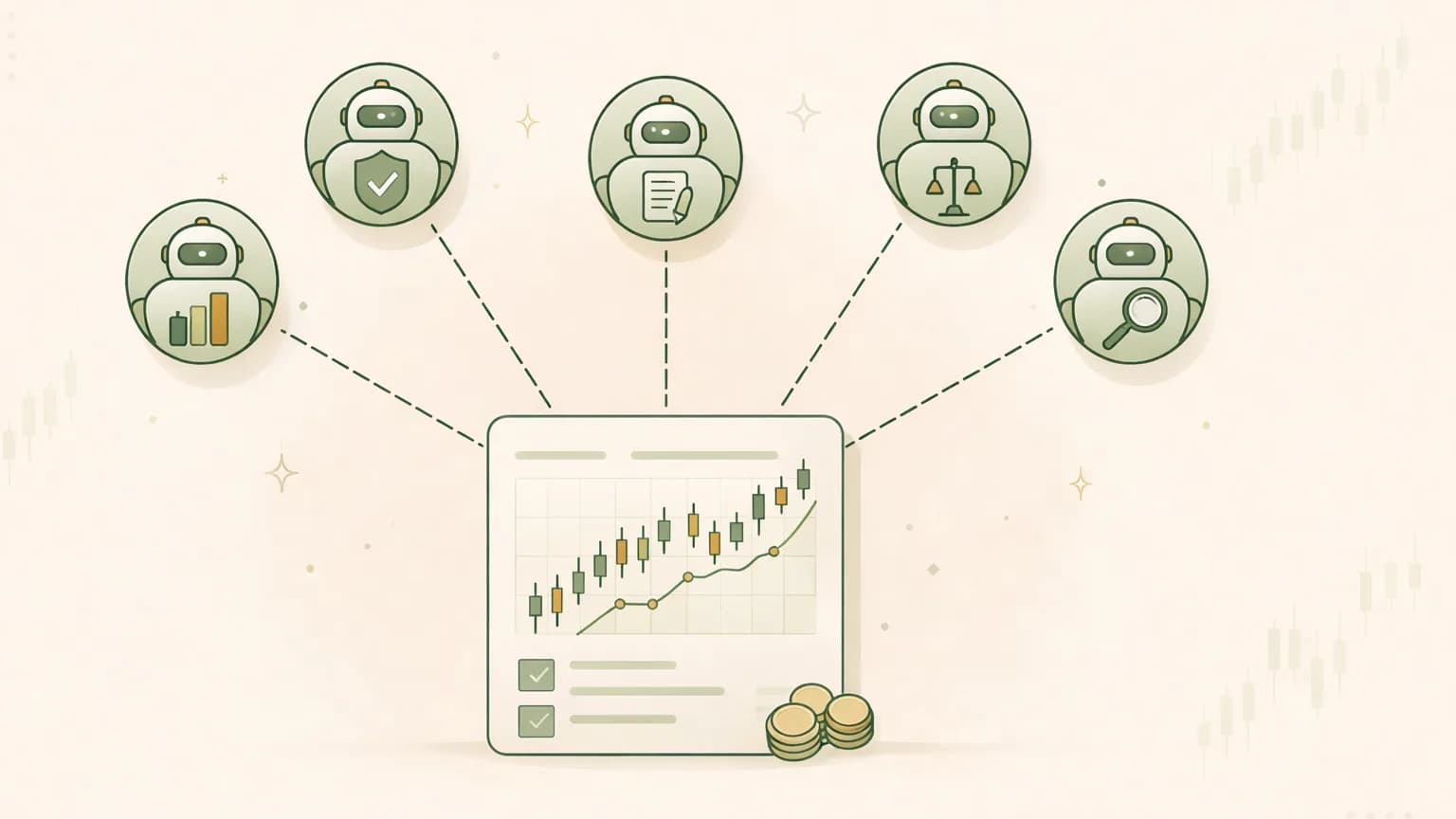
The alternative is to stop asking one model to be an entire research department. AI agents for stock analysis flip the model: instead of one system that does a little of everything, you run a team of narrow specialists, each responsible for one slice of the work — fundamentals, valuation, cash flow, sentiment, technicals, catalysts, risk — and then you make them argue before anyone writes a conclusion.
This guide walks through how that actually works: what each agent does, why grounding every claim in filings matters, how a structured bull-versus-bear debate turns a pile of opinions into a single research view, and how confidence and agreement scores tell you how much weight that view deserves. The point isn't a slicker answer. It's a checkable one.
Why one model and one score isn't enough#
A single general-purpose model has real strengths — it's fast, it's fluent, and it can summarize a lot of ground. But financial analysis punishes exactly the things a generalist is bad at.
The first problem is breadth masquerading as depth. Fundamentals, valuation, and sentiment are genuinely different disciplines. The skills that let you read a cash-flow statement are not the skills that let you interpret unusual options activity or judge whether a news cluster actually changes a thesis. When one model handles all of them in a single pass, each gets a thin, surface-level treatment — and the writing sounds equally authoritative about the parts it did well and the parts it half-did.
The second problem is no internal disagreement. A lone model has no structural reason to build the strongest case against its own conclusion. It tends to pick a direction early and then narrate toward it, because that produces the smoothest prose. The most important part of research — the reason you might be wrong — is the part a single confident pass is most likely to skip.
The third problem is one score with no meaning. A general model that ends with "7/10" or a made-up price target gives you a number with no anatomy. Is that a strong conclusion built on fresh filings, or a shaky one stitched from stale training data? You can't tell, because the score compresses data quality, agreement, and prediction into a single digit that explains none of them. (This is a big part of why an AI stock research platform is a different animal from an AI stock screener — the screener ranks, the research desk reasons.)
What "specialist AI agents" actually means#
The core idea is division of labor. Instead of one model wearing every hat, each agent is given one job, one lens, and the data that job needs — and it's judged only on that slice. Think of it as a research desk where every seat has a specialist in it.
A well-designed roster covers the same ground a human analyst team would, split roughly like this:
- The business and fundamentals — how the company makes money, revenue trends, margins, and financial quality. Is the growth real and durable, or dressed up with new metrics?
- Cash flow and the balance sheet — does reported profit turn into actual cash, and can the company survive a bad year? Earnings are an opinion; cash is a fact.
- Valuation — what you're being asked to pay for that stream of cash, measured against the company's own history and its peers, never in a vacuum.
- Ownership and insiders — what executives, directors, and institutions are doing, reported as third-party filings rather than as instructions.
- Sentiment and news — how the crowd feels and whether recent headlines actually change the story or just the mood.
- Technicals — what the price and volume are doing, kept firmly in their lane as a description of crowd behavior and timing, not a verdict on the business.
- Catalysts, sector, and macro — what's coming (earnings, launches, regulatory decisions) and the industry and economic backdrop those events land in.
- Risk — a dedicated seat whose entire job is to find what breaks the thesis.
Splitting the work this way is the whole reason multi-lens analysis beats a single narrator. Each of these disciplines answers a different question, and blending them into one pass loses the distinctions — which is exactly the tension we unpack in fundamental vs. technical vs. sentiment analysis. A specialist can go deep on its slice precisely because it isn't also trying to do the other seven.
Grounding: every agent starts from the filings, not from memory#
Specialization only helps if the specialists are working from real evidence. This is where a lot of AI analysis quietly falls apart: a fluent model reconstructs a "revenue figure" from half-remembered training data, presents it as current, and you have no way to know it's months stale or simply invented.
The fix is grounding. Before an agent reasons, it's fed primary sources — SEC filings (10-Ks and 10-Qs for the financials, Form 4s for insider transactions), market data, and licensed feeds — and its job is to interpret those, not to freelance from memory. Two rules make this trustworthy:
- Traceability. Every material claim — a margin, a debt maturity, an insider sale — should point back to where it came from. A claim you can't trace isn't research; it's an assertion in a nice font.
- An as-of date. Numbers go stale. Stamping each data point with the date it's current as of is the difference between "here's the latest filing" and "here's something that sounds right." If a term or filing type is unfamiliar, the glossary explains what each one contains.
Grounding is also the single biggest defense against hallucination. An agent working from a document can be checked against that document; an agent floating free of sources can't be checked at all. It's the foundation for the trust checklist we lay out in can you trust AI stock analysis — and it only works because each specialist is close enough to its own slice to actually read the primary source rather than skim it.
The part most tools skip: the bull-versus-bear debate#
Here's where a multi-agent process stops being "several summaries in a trench coat" and becomes something genuinely different.
Once the specialists have done their work, the strongest bull case and the strongest bear case are built as opposing arguments — deliberately, adversarially, each drawing on the specialists' findings. One side assembles every reason the thesis holds. The other side attacks it: the margin that's quietly eroding, the customer concentration nobody's pricing in, the valuation that only works if growth never slows. Then a risk seat pressure-tests both.
This matters because a one-sided report is a red flag no matter how well argued. If the best reason you might be wrong is missing, the most important part of the analysis is missing. Forcing the disagreement into the open does two things a single model can't: it surfaces the weak points of the bullish story, and it stops the bearish story from being a lazy "everything is terrible" that ignores the actual strengths.
There's also a reliability payoff. When multiple specialists have to reconcile their views against each other, a claim that only one agent invented tends to get challenged rather than waved through — which is the mechanism behind why multi-agent debate reduces AI hallucination. Structured disagreement is a feature, not a bug.
从辩论到单一研究视角#
无法解决的辩论只是噪音,因此最后一步是综合:将论点权衡并调和成一个 研究视角。至关重要的是,这个视角是中立的立场,而不是一个命令。在 Valarn 的案例中,梯度分为看涨、谨慎看涨、中立、谨慎或看跌——这是对证据倾向的描述,而不是“买入”或“卖出”。这种区别不是法律上的细节;它是分析所能告诉你的诚实界限。研究澄清了情况。你对此的处理是你自己的事。
同样重要的是,平台自身的观点与华尔街的看法 分开 报告。分析师评级和价格目标是真实的、有用的事实——因此它们作为第三方事实呈现,与独立研究视角并列,而不是混合在一起。你可以看到机器的解读与华尔街的意见一致或不一致,而不是将两者静默地平均成糊状。
两个分数告诉你有多少信任这个视角#
一个结论的有用性仅取决于你对它的依赖程度。这就是两个独立的 0–100 分数比一个模糊数字更有用的地方:
- 信心 衡量 数据质量——基础证据的新鲜度、完整性和一致性。它 不是 对股票会上涨或下跌的预测。高信心分数表示“此分析的输入是可靠的”,这与“这会成功”是完全不同的说法。稀薄、陈旧或相互矛盾的数据应该降低信心,而诚实的分析则允许这样。
- 一致性 衡量 专家们的趋同程度。当大多数代理指向同一方向时,一致性高,视角连贯。当基本面看起来强劲但情绪和技术指标发出谨慎信号时,一致性低——这种紧张关系是 信息,而不是需要掩盖的东西。
将这两者分开使它们变得有用。这里有一个说明性例子(数字仅供说明):一份报告可能会显示 信心 82,因为它基于刚提交的 10-Q,数据干净且一致——同时显示 一致性 54,因为估值和现金流代理喜欢这个设置,但技术和情绪代理则不喜欢。这种组合告诉你单一的“7/10”永远无法传达的内容:事实 是可靠的,但 专家们对其含义存在分歧。这就是你阅读辩论的信号,而不仅仅是标题。
情景范围而不是虚假的价格目标#
注意在这一切中故意缺失的内容:一个单一的自信价格目标。像“公允价值:$214”这样的精确数字暗示了一种诚实分析所没有的精确性。相反,一个良好的流程给你提供一个 情景范围——一个熊市、基准和牛市案例——以 参考价格 为锚,并配以 风险水平。
这种框架更真实,因为它符合未来的实际表现:作为不同可能性的结果范围,而不是一个注定的数字。它也直接与辩论相连——你争论出的牛市和熊市案例成为范围的上限和下限,因此你看到的数字显然是推理的产物,而不是最后随意给出的猜测。
在任何内容到达你之前的质量保证门#
最后一部分是监督。在合成报告交付之前,它会通过一个 QA 门——一个结构化检查,确保声明来源可靠,数据不陈旧,所需部分齐全,并且没有自相矛盾。可以把它看作是编辑在发布之前阅读桌面工作的过程,捕捉到来源但陈旧的数字或偏离证据的结论。
这就是将研究过程与一次性表现区分开的“结构化监督”。单一模型没有编辑;它将其初稿作为最终答案输出。一个带有 QA 门的多代理桌旨在在你继承之前捕捉到自己的错误。
单一模型与多代理研究桌#
以下是一个对比视图:
| 单一通用模型 | 多代理研究桌 | |
|---|---|---|
| 覆盖范围 | 对所有内容进行一次性处理,主题较薄 | 每个切片一个专家,深入研究每个主题 |
| 证据 | 通常从记忆中重建 | 基于文件/数据,带有截至日期 |
| 分歧 | 无——叙述朝向一个视角 | 明确的牛市与熊市辩论 |
| 输出 | 一个分数 / 一个价格目标 | 研究视角 + 信心 + 一致性 + 情景范围 |
| 信任信号 | “听起来很自信” | 可追溯的声明,QA 门,可读的轨迹 |
| 华尔街观点 | 混合或忽略 | 作为第三方事实单独报告 |
该表并不是说通用模型毫无用处——它快速且确实对初步评估有帮助。它是在说这两者是为不同的工作而构建的。
Valarn 中如何整合这些#
以上所有内容描述了一种架构,而这正是 Valarn 作为教育研究工具所运行的架构。单一分析召集多达 25 名专业 AI 分析师,分为五组——核心研究、市场结构、辩论与风险、财务质量,以及事件/行业与宏观——涵盖基本面、估值、财务质量、现金流、内部人和所有权活动、情绪和新闻、技术指标、催化剂、行业和宏观。
这些专家进行正式的 牛市与熊市辩论,最终汇聚成一个中立的 研究视角——绝不是买入/卖出指令。每个事实声明都可以追溯到一个文件或带有截至日期的授权来源;报告携带两个 0–100 分数(信心用于数据质量,一致性用于分析师趋同);它将结果框架为一个 情景范围,配有参考价格和风险水平,而不是单一目标;并且它将 华尔街共识单独报告,与其自身观点分开。在任何内容到达你之前都有一个 QA 门。你可以在 功能概述 或 为什么选择 Valarn 页面上看到这些部分是如何结合在一起的。
这里的诚实承诺是有意狭窄的:不是说这能预测市场,而是它给你提供一个你可以实际检查的研究过程。如果你想在真实公司上看到它,可以浏览 完整样本报告,查找任何股票代码在 公司研究页面 上,或 进行自己的免费分析,亲自阅读辩论。
结论#
从“询问一个 AI”到“为股票分析运行一个专业 AI 代理团队”的转变并不是关于更华丽的答案。这是关于结构:狭窄的专家基于文件,强迫辩论双方,综合成一个中立的研究视角,按数据质量和一致性评分,以范围而非预言的形式框架,并在你看到之前通过 QA 门进行检查。
一个自信的段落要求你信任其语气。一个多代理过程则提供了一条你可以从来源走到结论的轨迹——分歧保持可见。理解代理的工作方式,你将确切知道任何 AI 报告中哪些部分值得相信,哪些部分需要质疑。
Valarn 是一个教育研究工具,而不是投资建议。它不告诉你购买、出售或持有任何东西,这里没有任何推荐或结果的承诺。始终进行自己的研究,并考虑咨询持牌金融专业人士。
Valarn
AI Research
Valarn Research Team

Try Valarn for free
Run AI-powered analysis on any stock — typically 5–20 minutes per report.