Three Honest Tools, Not One Magic Backtest#
Sooner or later, everyone building a process around AI research asks the same thing: "Does this actually work?"
Valarn gives you three separate tools to explore that question over time — but it's important to be clear-eyed about what each one is. None of them is a prediction, a win rate, or a track record. They answer different questions, and confusing them leads to bad conclusions.
- Backtest Mode — run the full research as of a past date, with no look-ahead.
- The mechanical price backtest — test a transparent trading rule on past prices.
- Research Accuracy — see how a report's research stance aged after the fact.
Let's take them one at a time.
1. Backtest Mode: Run the Research As of a Past Date#
Backtest Mode sets a historical trade date and runs the full multi-agent analysis as if today were that date. The agents only see information that existed on or before the date you pick.
To use it: open Run Analysis, expand Advanced Settings, find the Run Mode section, and toggle Backtest Mode. A Trade date field appears. The helper text says it plainly — "Agents will only use data available on or before this date."
Under the hood, that date flows through the agents: SEC filings are read as of that date, the news and sentiment window ends on that date, and macro data reflects what was known at the time. There's no peeking at what happened next.
What you get is a normal research report, as of that date — the same research view, confidence, agents, and debate you'd see on a live run. There is no separate "score" or "was it right?" panel, because that's not what this tool is for. It answers a narrower, more honest question: how would the agents have framed this setup at the time, given only what was knowable then? That makes it useful for understanding the research process, studying a historical inflection point, or comparing how a company looked then versus now.
2. The Mechanical Price Backtest: Test a Rule on Past Prices#
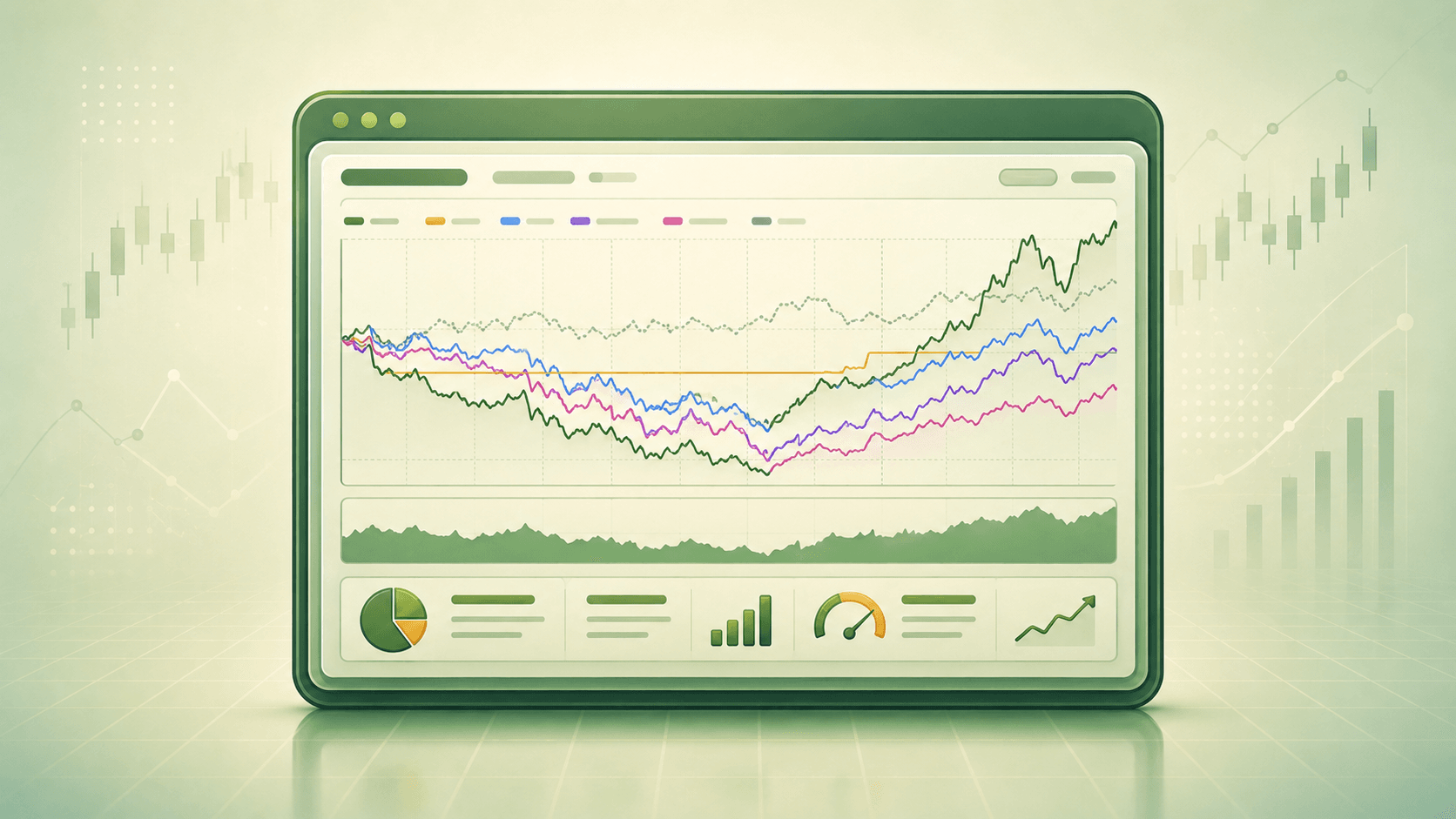
Completely separate from the AI, Valarn includes a classic price backtest — a simulation of a simple, transparent trading rule on a stock's historical prices. You'll find it as the Backtest section of any report, and as its own hub under Backtest in the sidebar, with tabs for Strategy Lab, Single Stock, Portfolio, and Screen.
Pick a strategy — Valarn Composite, Buy & Hold, Trend (50-day), MA Crossover, RSI Mean Reversion, or 52-Week Breakout — and Valarn runs it over historical daily prices and reports the usual quant metrics: total return, excess return versus a benchmark, CAGR, Sharpe ratio, maximum drawdown, win rate, profit factor, an equity curve, and a trade list. It runs on free public price data, and there's an optional "Explain with AI" summary on paid plans.
One caveat matters more than any of those numbers, and Valarn states it right on the panel: the "Valarn Composite" strategy is a transparent, labeled proxy — NOT a replay of the AI research score. A price backtest tells you how a mechanical rule would have behaved on past prices. It does not tell you how Valarn's AI research would have performed, and it is not advice. Treat it as an educational simulation of a rule, nothing more.
3. Research Accuracy: How a Stance Aged#
The closest thing to "did the research hold up?" is the Research Accuracy card on a report — and notice what it does not do: it never grades a signal right or wrong.
Instead, it shows how that report's research stance has aged since it was published — at 1, 5, 30, and 90 days — both in absolute terms and relative to the S&P 500 and the stock's sector. Each window carries a plain, honest label: aged well, mixed, aged poorly, or too early to assess.
Valarn is deliberate about this framing and says so on the card itself: it's about how a stance "has aged … calibration, not performance." (Organization-wide calibration summaries are available on Enterprise plans.)
The disclaimer is worth repeating, because it is the point: this is quality-monitoring and research calibration only. Past outcomes do not predict future results, and they are not a record of investment performance or of any user's returns.
Using All Three Together#
Used honestly, these tools help you build calibrated judgment about how to read Valarn's research — not a trading system:
- Backtest Mode shows you the research process on historical setups, with no hindsight leaking in.
- The price backtest shows how transparent mechanical rules behaved on past prices — clearly separate from the AI.
- Research Accuracy shows, over time, whether a stance tended to age well — as calibration, never as a track record.
What none of them do is promise a win rate, a "signal accuracy," or a future return. Even a well-founded research view will look wrong a meaningful share of the time — markets are uncertain, and pretending otherwise would be dishonest.
The Bottom Line#
Backtesting in Valarn is about understanding, not proving. Run the research as of a past date to see how the agents reason with period-accurate data. Use the mechanical price backtest to sanity-check simple rules — remembering it isn't the AI. And watch Research Accuracy over time to calibrate how much weight a given stance deserves.
Every one of these is educational and descriptive — a way to think more clearly about the research, not a guarantee of what happens next.
Valarn
Customer Success
Valarn Research Team
