
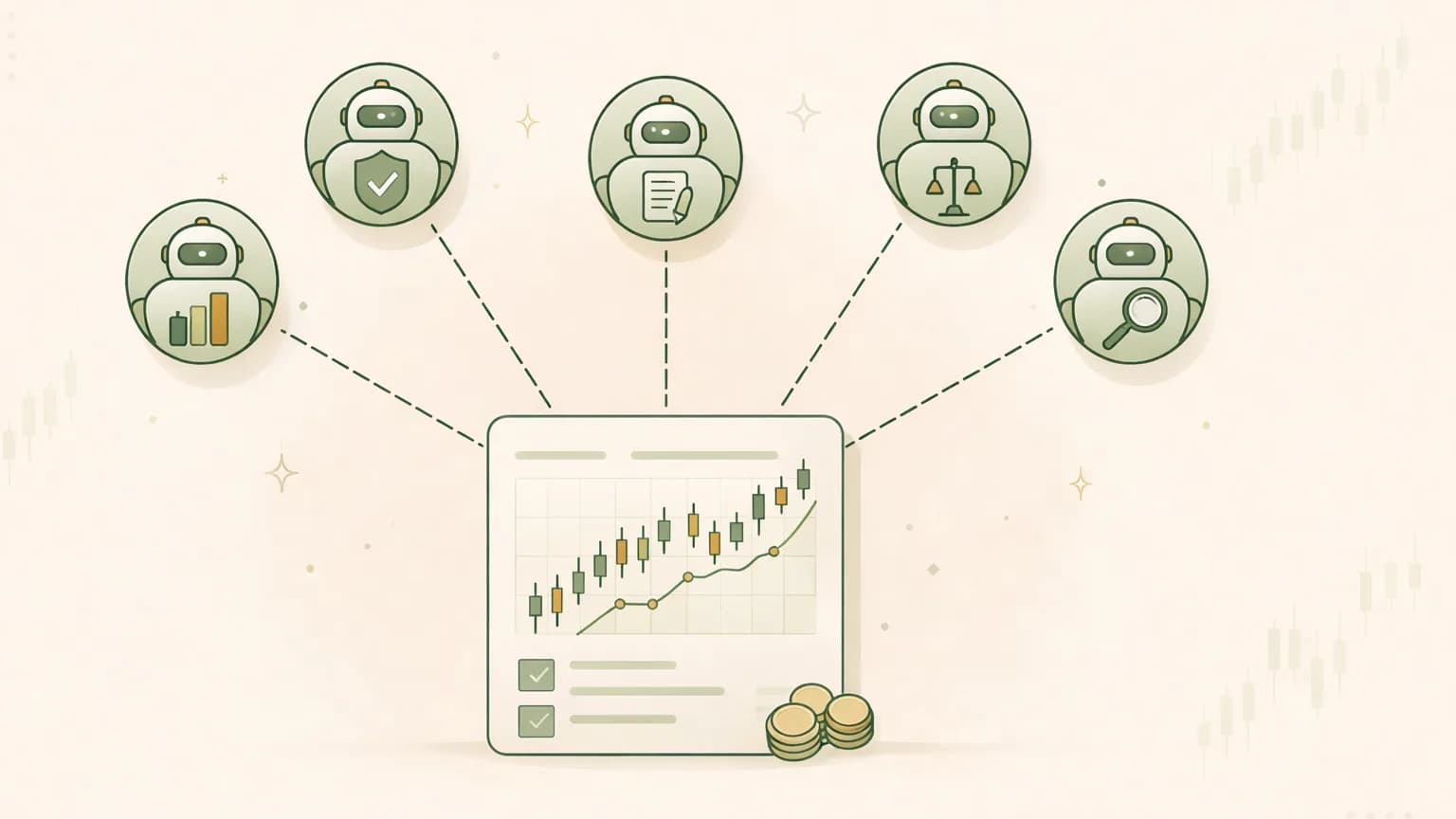
Ask an AI to analyze a stock and you'll usually get one model doing everything at once — skimming the business, guessing at valuation, sampling the news, and handing you a single confident paragraph with maybe a number stapled to the end. It reads well. That's the trap. One generalist making one pass has no way to disagree with itself, and no way to show you where its own case is weak.
The alternative is to stop asking one model to be an entire research department. AI agents for stock analysis flip the model: instead of one system that does a little of everything, you run a team of narrow specialists, each responsible for one slice of the work — fundamentals, valuation, cash flow, sentiment, technicals, catalysts, risk — and then you make them argue before anyone writes a conclusion.
This guide walks through how that actually works: what each agent does, why grounding every claim in filings matters, how a structured bull-versus-bear debate turns a pile of opinions into a single research view, and how confidence and agreement scores tell you how much weight that view deserves. The point isn't a slicker answer. It's a checkable one.
Why one model and one score isn't enough#
A single general-purpose model has real strengths — it's fast, it's fluent, and it can summarize a lot of ground. But financial analysis punishes exactly the things a generalist is bad at.
The first problem is breadth masquerading as depth. Fundamentals, valuation, and sentiment are genuinely different disciplines. The skills that let you read a cash-flow statement are not the skills that let you interpret unusual options activity or judge whether a news cluster actually changes a thesis. When one model handles all of them in a single pass, each gets a thin, surface-level treatment — and the writing sounds equally authoritative about the parts it did well and the parts it half-did.
The second problem is no internal disagreement. A lone model has no structural reason to build the strongest case against its own conclusion. It tends to pick a direction early and then narrate toward it, because that produces the smoothest prose. The most important part of research — the reason you might be wrong — is the part a single confident pass is most likely to skip.
The third problem is one score with no meaning. A general model that ends with "7/10" or a made-up price target gives you a number with no anatomy. Is that a strong conclusion built on fresh filings, or a shaky one stitched from stale training data? You can't tell, because the score compresses data quality, agreement, and prediction into a single digit that explains none of them. (This is a big part of why an AI stock research platform is a different animal from an AI stock screener — the screener ranks, the research desk reasons.)
What "specialist AI agents" actually means#
The core idea is division of labor. Instead of one model wearing every hat, each agent is given one job, one lens, and the data that job needs — and it's judged only on that slice. Think of it as a research desk where every seat has a specialist in it.
A well-designed roster covers the same ground a human analyst team would, split roughly like this:
- The business and fundamentals — how the company makes money, revenue trends, margins, and financial quality. Is the growth real and durable, or dressed up with new metrics?
- Cash flow and the balance sheet — does reported profit turn into actual cash, and can the company survive a bad year? Earnings are an opinion; cash is a fact.
- Valuation — what you're being asked to pay for that stream of cash, measured against the company's own history and its peers, never in a vacuum.
- Ownership and insiders — what executives, directors, and institutions are doing, reported as third-party filings rather than as instructions.
- Sentiment and news — how the crowd feels and whether recent headlines actually change the story or just the mood.
- Technicals — what the price and volume are doing, kept firmly in their lane as a description of crowd behavior and timing, not a verdict on the business.
- Catalysts, sector, and macro — what's coming (earnings, launches, regulatory decisions) and the industry and economic backdrop those events land in.
- Risk — a dedicated seat whose entire job is to find what breaks the thesis.
Splitting the work this way is the whole reason multi-lens analysis beats a single narrator. Each of these disciplines answers a different question, and blending them into one pass loses the distinctions — which is exactly the tension we unpack in fundamental vs. technical vs. sentiment analysis. A specialist can go deep on its slice precisely because it isn't also trying to do the other seven.
Grounding: every agent starts from the filings, not from memory#
Specialization only helps if the specialists are working from real evidence. This is where a lot of AI analysis quietly falls apart: a fluent model reconstructs a "revenue figure" from half-remembered training data, presents it as current, and you have no way to know it's months stale or simply invented.
The fix is grounding. Before an agent reasons, it's fed primary sources — SEC filings (10-Ks and 10-Qs for the financials, Form 4s for insider transactions), market data, and licensed feeds — and its job is to interpret those, not to freelance from memory. Two rules make this trustworthy:
- Traceability. Every material claim — a margin, a debt maturity, an insider sale — should point back to where it came from. A claim you can't trace isn't research; it's an assertion in a nice font.
- An as-of date. Numbers go stale. Stamping each data point with the date it's current as of is the difference between "here's the latest filing" and "here's something that sounds right." If a term or filing type is unfamiliar, the glossary explains what each one contains.
Grounding is also the single biggest defense against hallucination. An agent working from a document can be checked against that document; an agent floating free of sources can't be checked at all. It's the foundation for the trust checklist we lay out in can you trust AI stock analysis — and it only works because each specialist is close enough to its own slice to actually read the primary source rather than skim it.
The part most tools skip: the bull-versus-bear debate#
Here's where a multi-agent process stops being "several summaries in a trench coat" and becomes something genuinely different.
Once the specialists have done their work, the strongest bull case and the strongest bear case are built as opposing arguments — deliberately, adversarially, each drawing on the specialists' findings. One side assembles every reason the thesis holds. The other side attacks it: the margin that's quietly eroding, the customer concentration nobody's pricing in, the valuation that only works if growth never slows. Then a risk seat pressure-tests both.
This matters because a one-sided report is a red flag no matter how well argued. If the best reason you might be wrong is missing, the most important part of the analysis is missing. Forcing the disagreement into the open does two things a single model can't: it surfaces the weak points of the bullish story, and it stops the bearish story from being a lazy "everything is terrible" that ignores the actual strengths.
There's also a reliability payoff. When multiple specialists have to reconcile their views against each other, a claim that only one agent invented tends to get challenged rather than waved through — which is the mechanism behind why multi-agent debate reduces AI hallucination. Structured disagreement is a feature, not a bug.
議論から単一の研究ビューへ#
解決できない議論はただの雑音であるため、最後のステップは統合です:議論は評価され、一つの研究ビューに調和されます。重要なのは、そのビューが中立的な立場であり、命令ではないことです。Valarnの場合、階層は強気、慎重な強気、中立、慎重、または弱気であり、証拠がどの方向に傾いているかを示すものであり、決して「買い」や「売り」ではありません。この区別は法的な細かさではなく、分析があなたに何を伝えられるかの正直な限界です。研究は状況を明確にします。それに対してあなたが何をするかはあなた次第です。
同様に重要なのは、プラットフォーム自身の見解がウォール街の考えとは別に報告されることです。アナリストの評価や価格目標は実際の、有用な事実であるため、独立した研究ビューと並んで第三者の事実として提示され、混合されることはありません。機械の読み取りがストリートと一致するかどうかを確認できるように、二つが静かに平均化されてぼやけることはありません。
見解を信頼する程度を示す二つのスコア#
結論は、どれだけそれに依存するかの感覚に応じてのみ有用です。ここで、二つの別々の0–100スコアが、一つの曖昧な数字よりもはるかに多くの作業を行います:
- 信頼度はデータの質を測定します — 基礎となる証拠がどれだけ新鮮で、完全で、一貫しているか。これは株価が上がるか下がるかの予測ではありません。高い信頼度スコアは「この分析の入力は堅実である」と言い、これは「これがうまくいく」という主張とは全く異なります。薄い、古い、または矛盾するデータは信頼度を下げるべきであり、正直な分析はそれを許します。
- 合意は専門家がどれだけ収束したかを測定します。ほとんどのエージェントが同じ方向を指すとき、合意は高く、見解は一貫しています。ファンダメンタルが強そうに見えるが、センチメントやテクニカルが警戒を示しているとき、合意は低くなります — その緊張は情報であり、覆い隠すべきものではありません。
これら二つを分けておくことが、それらを有用にします。以下は説明的な例です(数字は例示のみ):レポートは信頼度82を持つかもしれません。これは、クリーンで一貫したデータを持つ最近提出された10-Qに基づいているためです — 一方で合意54を示すかもしれません。これは、評価とキャッシュフローのエージェントがその設定を好むが、テクニカルとセンチメントのエージェントはそうではないからです。その組み合わせは、単一の「7/10」では決して伝えられないことを教えてくれます:事実は信頼できるが、専門家はそれが何を意味するかについて意見が異なるということです。それが議論を読む合図であり、見出しだけではありません。
偽の価格目標ではなくシナリオ範囲#
これらすべてから意図的に欠けているものに注目してください:単一の自信ある価格目標。"公正価値:$214"のような正確な数字は、正直な分析が持つことのない精度を暗示します。代わりに、よく構築されたプロセスはシナリオ範囲を提供します — 弱気、ベース、強気のケース — 基準価格に基づき、リスクレベルとペアになっています。
この枠組みは、未来が実際にどのように振る舞うかに一致するため、より真実です:異なる可能性を持つ結果の広がりとして、決して一つの運命づけられた数字ではありません。また、議論に直接つながります — あなたが議論した強気と弱気のケースが範囲の上限と下限になり、あなたが見ている数字は明らかにその推論の産物であり、最後に投げ込まれた推測ではありません。
あなたに届く前の品質保証ゲート#
最後の部分は監視です。統合されたレポートが配信される前に、QAゲートを通過します — 主張が出所されているか、データが古くないか、必要なセクションが存在するか、何も自己矛盾していないかを確認する構造化されたチェックです。これは、デスクの作業を出荷前に読む編集者のように考えてください。出所はあるが古い数字や、証拠から逸脱した結論を見つけます。
これは、研究プロセスを一回限りのパフォーマンスから分ける「構造化された監視」です。単一のモデルには編集者がいません;それは最初のドラフトを最終的な答えとして出力します。QAゲートを持つマルチエージェントデスクは、あなたがそれらを受け取る前に自らのミスをキャッチするように構築されています。
単一モデル vs. マルチエージェント研究デスク#
以下は一つの視点での対比です:
| 単一の一般モデル | マルチエージェント研究デスク | |
|---|---|---|
| カバレッジ | すべてを一度通過、トピックごとに薄い | 各スライスごとに専門家、各々深く |
| 証拠 | 記憶から再構築されることが多い | 提出物/データに基づき、日付付き |
| 意見の不一致 | なし — 一つの見解に向かって語る | 明示的な強気対弱気の議論 |
| 出力 | 一つのスコア / 一つの価格目標 | 研究ビュー + 信頼度 + 合意 + シナリオ範囲 |
| 信頼信号 | 「自信があるように聞こえる」 | 追跡可能な主張、QAゲート、読みやすいトレイル |
| ウォール街の見解 | 混合されるか無視される | 第三者の事実として別に報告される |
この表は一般モデルが無用であると言っているわけではありません — それは迅速で、初回の通過に本当に役立ちます。二つのものは異なる仕事のために構築されていると言っています。
Valarnでの統合#
上記のすべてはアーキテクチャを説明しており、Valarnが教育的研究ツールとして運営しているものです。単一の分析は、コア研究、マーケット構造、議論とリスク、財務の質、イベント/セクターとマクロの五つのグループに組織された最大約25人の専門AIアナリストを招集します — ファンダメンタル、評価、財務の質、キャッシュフロー、インサイダーおよび所有権活動、センチメントとニュース、テクニカル、カタリスト、セクター、マクロをカバーします。
これらの専門家は正式な強気対弱気の議論を提供し、それが一つの中立的な研究ビューに解決されます — 決して買い/売りの指示ではありません。すべての事実の主張は、提出物または日付付きのライセンスされたソースに追跡可能であり;レポートは二つの0–100スコア(データの質のための信頼度、アナリストの収束のための合意)を持ち;結果を単一の目標ではなく、基準価格とリスクレベルを持つシナリオ範囲として枠付けします;そして、ウォール街のコンセンサスを自らの見解とは別に報告します。あなたに届く前に、QAゲートが実行されます。どのように部品が組み合わさるかは、機能の概要やwhy-Valarnページで見ることができます。
ここでの正直な約束は、意図的に狭いものです:市場を予測するのではなく、実際に検査できる研究プロセスを提供することです。実際の企業でそれを見たい場合は、完全なサンプルレポートをざっと見たり、企業研究ページで任意のティッカーを調べたり、自分自身で無料分析を実行して議論を自分で読むことができます。
結論#
「一つのAIに尋ねる」から「株式分析のために専門AIエージェントのチームを運営する」へのシフトは、より洗練された答えについてではありません。構造についてです:提出物に基づいた狭い専門家、両側を議論することを強いられ、中立的な研究ビューに統合され、データの質と合意のためにスコア付けされ、予言ではなく範囲として枠付けされ、あなたがそれを見る前にQAゲートによってチェックされます。
単一の自信ある段落は、あなたにトーンを信頼するよう求めます。マルチエージェントプロセスは、ソースから結論まで歩けるトレイルを手渡します — 意見の不一致が可視化されたままです。エージェントがどのように機能するかを理解すれば、どのAIレポートの部分を信じ、どの部分を問いただすべきかを正確に知ることができます。
Valarnは教育的研究ツールであり、投資アドバイスではありません。何かを買う、売る、または保持するように指示するものではなく、ここにあるものは推奨や結果の約束ではありません。常に自分自身で研究を行い、ライセンスを持つ金融専門家に相談することを検討してください。
Valarn
AI Research
Valarn Research Team

Try Valarn for free
Run AI-powered analysis on any stock — typically 5–20 minutes per report.