A company can boost its earnings per share without selling a single extra product, hiring anyone, or improving a thing about how it operates. It just buys back its own stock. That maneuver — the buyback — is one of the biggest uses of corporate cash in the market, and one of the most misunderstood.
Here's the honest version of stock buybacks explained: a repurchase is neither the shareholder gift it's often sold as nor the accounting trick cynics claim. It's a capital-allocation decision, and like any such decision it creates value in some situations and destroys it in others. The entire difference comes down to one question most headlines skip.
This guide walks through what a buyback actually is, how it flatters the numbers, where the value really comes from, and the red flags — dilution offsets, debt-funded repurchases, and management pay tied to the very metric buybacks inflate — that separate a smart repurchase from an expensive one.
What a buyback actually is#
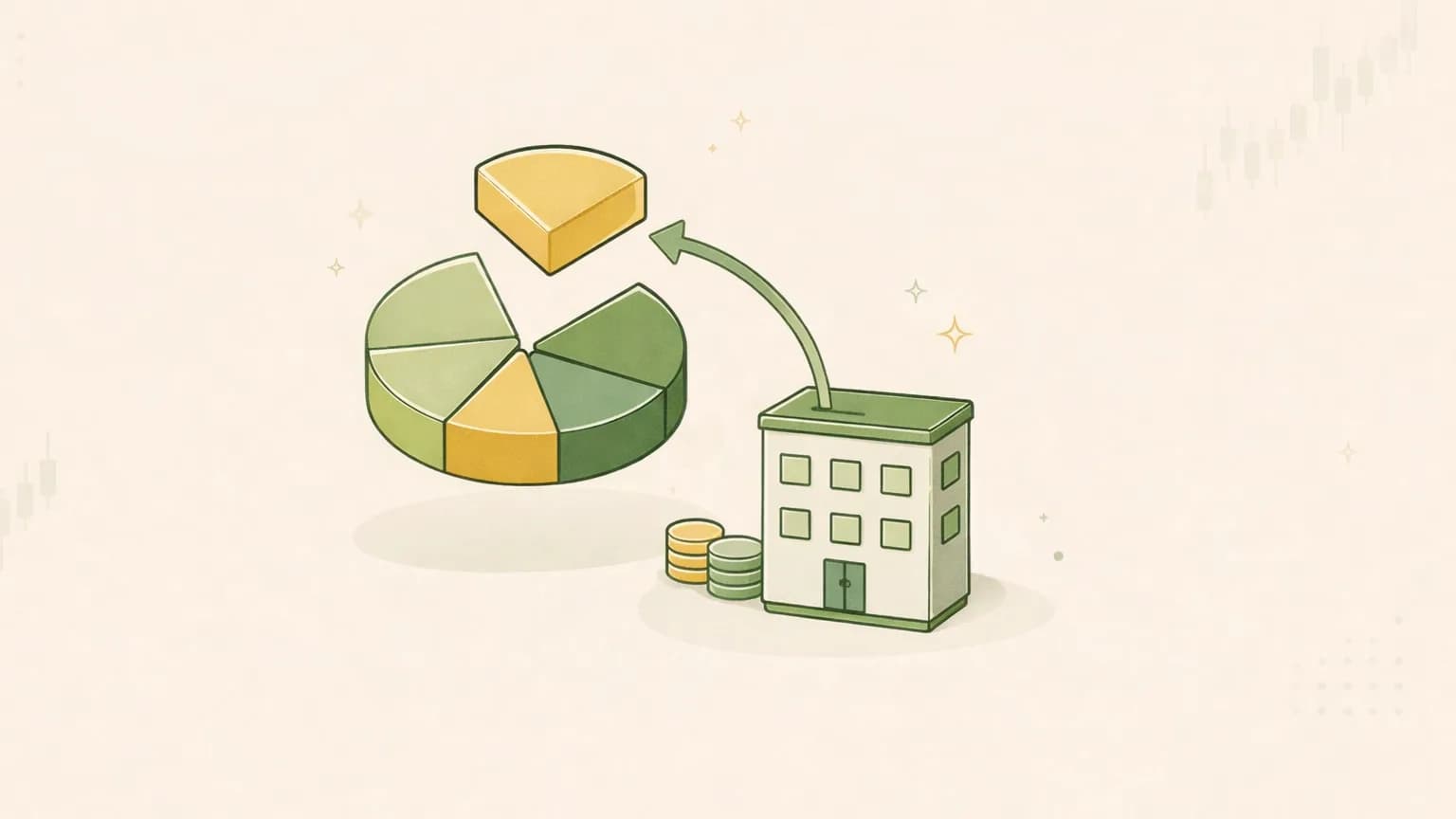
When a company buys back stock, it uses its own cash to purchase shares on the open market and retire them. Those shares stop existing. The result is fewer shares outstanding, which means every remaining share now represents a slightly larger slice of the same company.
Think of a pizza cut into eight slices. A buyback doesn't add pizza — it removes a couple of slices and hands the rest out among fewer people. Each remaining slice is bigger, but the pie is the same size. That's the crucial mental model: a buyback rearranges ownership of the business. It does nothing, by itself, to make the business better.
Companies frame repurchases as "returning capital to shareholders," and in a sense they are — cash leaves the company and, indirectly, accrues to the people who still hold shares. But whether that's a good use of the cash depends entirely on the price paid. Hold that thought; it's the whole ballgame.
How buybacks lift EPS#
The most visible effect of a buyback shows up in earnings per share, and this is where a lot of the mythology lives. EPS is just net income divided by shares outstanding. Shrink the denominator and — with the numerator unchanged — EPS rises automatically.
Here's an illustrative example (the numbers are made up to show the mechanics):
- A company earns $100 million in net income.
- It has 100 million shares outstanding.
- EPS = $100M ÷ 100M = $1.00.
Now it buys back 10% of its shares, leaving 90 million:
- EPS = $100M ÷ 90M = $1.11.
Earnings per share jumped about 11% — and the business earned exactly the same $100 million. Sales didn't grow, margins didn't improve, no new customer walked in the door. The "growth" is entirely arithmetic.
This matters because a lot of people, and a lot of headlines, treat EPS growth as proof a company is thriving. Sometimes it is. Sometimes it's a buyback doing the work. When you see EPS climbing, it's worth asking how much came from the company actually earning more versus simply having fewer shares to divide by. If you want the deeper mechanics of the metric itself, earnings per share explained breaks down what the number does and doesn't tell you.
The dilution offset almost nobody mentions#
Now for the part that quietly cancels a lot of buybacks: stock-based compensation.
Many companies, especially in tech, pay employees partly in stock. Every year they issue new shares to staff, which increases the share count — the opposite of a buyback. So a company can announce billions in repurchases and still see its share count barely move, because it's issuing nearly as many new shares out the back door as it's retiring out the front.
An illustrative version:
- The company buys back 10 million shares.
- The same year, it issues 8 million new shares to employees as compensation.
- Net reduction: only 2 million shares.
The press release trumpets a 10-million-share buyback. The actual dilution-adjusted benefit is a fifth of that. In cases like this, the repurchase isn't really "returning capital" to outside shareholders at all — it's mopping up the dilution created by paying employees in stock, using cash that could have gone elsewhere.
This is why sophisticated readers watch the net change in shares outstanding over several years, not the gross buyback headline. A buyback that merely offsets dilution keeps you running to stand still. For the two forces pulling on the share count, see stock-based compensation explained and stock dilution explained — the buyback story only makes sense once you understand both.
The one question that decides everything: price versus value#
Here's the principle that separates a value-creating buyback from a value-destroying one, and it's genuinely simple:
A buyback creates value for continuing shareholders only when the company buys its shares below their intrinsic worth. It destroys value when it overpays.
Why? Because when a company retires stock, the remaining owners are effectively "buying" the departing shareholders' stakes with company cash. If they buy those stakes cheap, the remaining owners get a bargain — more business per dollar spent. If they buy them expensive, the remaining owners overpaid on their own behalf, and that cash is gone.
An illustrative contrast:
- Suppose a share is genuinely worth about $10 of intrinsic value.
- Buying it back at $7 hands continuing owners roughly $10 of value for $7 of cash — a good deal for them.
- Buying that same share at $14 spends $14 to retire something worth $10 — value quietly leaks away, even as EPS still ticks up.
Notice the trap: the EPS boost happens either way. A buyback at a rich price still shrinks the share count and still lifts reported EPS, which is exactly why an overpriced buyback can look like success on the surface while eroding value underneath. Management can point to rising EPS while having spent shareholder cash badly.
The uncomfortable reality is that companies tend to have the most spare cash — and the most confidence — when their business is booming and their stock is expensive. They tend to be starved for cash when their stock is cheap. So buybacks are frequently biggest at exactly the wrong prices. Judging whether a repurchase is happening above or below fair value is its own discipline; our guide on how to tell if a stock is overvalued or undervalued covers the yardsticks involved.
Debt-funded buybacks: borrowing to shrink#
There's a difference between buying back stock with cash the business generates and borrowing money to do it. The first spends surplus. The second adds financial risk to juice a per-share number.
Debt-funded buybacks can look clever in good times: interest rates are low, borrowing is cheap, and swapping some equity for debt lifts EPS and metrics like return on equity. But you've now made the company more fragile. Debt has to be serviced through downturns; equity doesn't. A company that borrowed heavily to retire shares near a market peak can find itself over-leveraged precisely when a recession hits and cash gets tight — the worst possible moment.
The tell is to check whether repurchases are funded by genuine free cash flow — the cash left after the company reinvests in itself — or by a rising debt balance. A buyback paid for out of abundant free cash flow is a very different animal from one paid for with an expanding loan and a shrinking equity cushion. Same headline, opposite risk profile.
Buybacks versus dividends#
Buybacks and dividends are the two main ways companies return cash to shareholders, and they behave differently enough to compare directly:
| Buybacks | Dividends | |
|---|---|---|
| How you benefit | Higher ownership per share; potential price support | Cash paid directly to you |
| Flexibility | Easy to pause or cut quietly, no signal | Cutting one is a loud negative signal |
| Depends on price? | Yes — only smart if bought below fair value | No — value doesn't hinge on stock price |
| Taxes (general) | Often deferred until you sell | Usually taxed in the year received |
| Main risk | Overpaying; masking dilution | Straining cash to sustain the payout |
Neither is inherently better; they suit different situations. Dividends impose discipline — the cash is gone, so management can't fritter it away — and reward you whether or not the stock cooperates. Buybacks are flexible and can be value-accretive when shares are cheap, but that flexibility also lets a company quietly overpay with no one holding it accountable.
One caution worth carrying over: a fat dividend or aggressive buyback funded by a stretched balance sheet is not the sign of health it appears to be. The same logic that produces a dividend yield trap — a payout too large for the underlying cash to support — applies to repurchases bankrolled by debt.
Follow the incentives: EPS-linked pay#
Here's the part that ties the whole thing together, and it's why buybacks deserve a skeptical read rather than a cheer. Executive compensation is very often tied to EPS targets. And as you now know, a buyback lifts EPS mechanically, regardless of whether the business improved or whether the shares were a good buy.
So a management team paid on EPS growth has a direct personal incentive to repurchase stock — even at a rich price, even funded by debt, even when reinvesting in the business or paying down debt would serve shareholders better. The buyback hits their bonus target. Whether it created value for you is a separate question the bonus formula doesn't ask.
This isn't a claim that every buyback is self-serving. Plenty are excellent capital allocation. It's a reason to check how management is paid before you take a repurchase at face value. When you see aggressive buybacks at an elevated stock price by a team whose pay hinges on EPS, you've found something worth scrutinizing rather than applauding. Our guide on how executive pay is structured shows where these incentive lines are usually drawn.
How to read a buyback like an analyst#
Pulling it together, a repurchase is worth interrogating along a few axes rather than taking as automatically good news:
- Net share count, not the headline. Did shares outstanding actually fall over several years, or did stock-based comp cancel the buyback out?
- Price versus value. Is the company buying when its stock looks cheap relative to fundamentals, or piling in near highs?
- Funding source. Genuine free cash flow, or new debt and a thinning equity cushion?
- Consistency. Steady, opportunistic repurchases at sensible prices tell a different story than a sudden splurge that happens to land in a bonus year.
- Alternatives foregone. Was buying back stock genuinely the best use of the cash, versus reinvesting in growth, paying down debt, or a dividend?
None of these have a single "right" answer. They're the questions that turn a press release into an actual assessment — and running all of them, on filing after filing, is exactly the kind of tedious cross-checking that gets skipped.
Where a research desk fits in#
That cross-checking is a lot of work to do by hand, which is why Valarn exists as an educational research tool. Instead of one AI handing you a tidy paragraph about a "shareholder-friendly buyback," it convenes up to about 25 specialist analysts across five categories — from financial-quality and cash-flow analysts that trace whether repurchases are funded by real free cash flow, to an insider-and-ownership analyst that watches share-count and management-incentive signals, to a dedicated risk committee. They stage a structured bull-versus-bear debate and synthesize a single neutral research view (Bullish, Cautious Bullish, Neutral, Cautious, or Bearish — never a buy or sell instruction).
Every factual claim — the buyback size, the net change in shares, the debt used to fund it — is traceable to a filing or licensed source with an as-of date, and it all passes a quality-assurance gate before you see it. Each report carries two 0–100 scores: a confidence score reflecting data quality (not a price prediction) and an agreement score showing how much the analysts converged. Wall Street's consensus is reported separately from Valarn's own view, so you can see where they diverge. You can browse the full breakdown on the features page or skim a complete sample report to see how buyback signals actually surface. When you want to start from a specific name, a company research page is the quickest way in, and the glossary defines every term above.
The bottom line#
A buyback is a tool, not a verdict. It reliably lifts EPS whether or not it's a good idea, which is exactly why you can't judge one by the headline or the earnings bump. Value gets created only when a company buys its shares below what they're worth, with cash it genuinely has to spare — and gets quietly destroyed when it overpays, borrows to do it, or repurchases mainly to hit a pay target.
So read buybacks the way you'd read any capital-allocation decision: check the net share count, the price paid, the funding, and the incentives behind it. Do that, and "the company is buying back stock" stops being a talking point and becomes something you can actually evaluate. Curious how it looks on a real company? Explore a sample report or run your own free analysis and see the buyback signals for yourself.
Valarn is an educational research tool, not investment advice. It does not tell you to buy, sell, or hold anything, and nothing here is a recommendation or a promise of results. Always do your own research and consider consulting a licensed financial professional.
Valarn
Research
Valarn Research Team
